Caught in a rip current while swimming: what to do?
Rip currents can pull even strong swimmers away from shore. Learn the correct actions to escape safely and help others without becoming a victim.
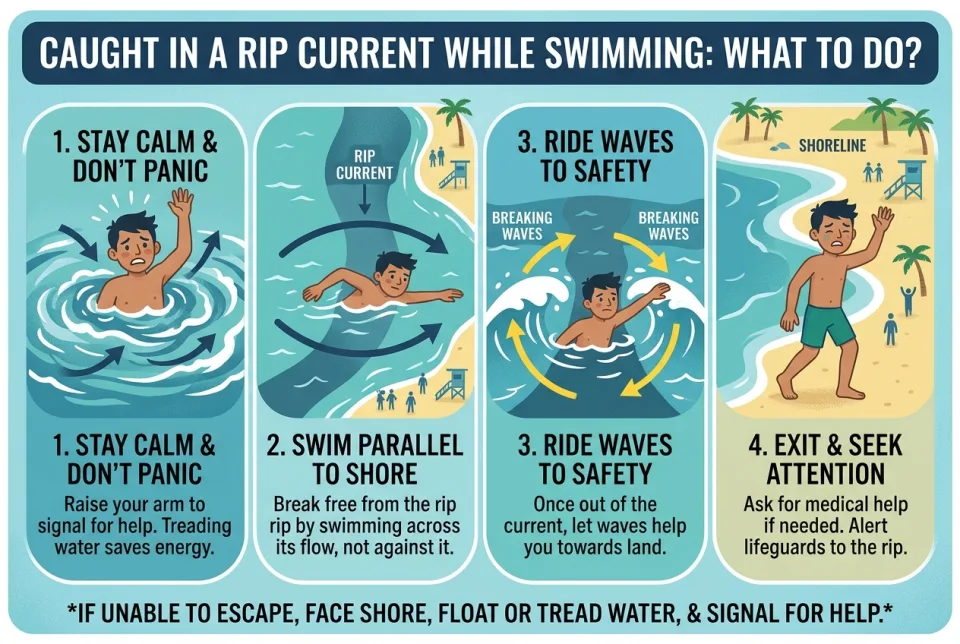
Quick answer
4 steps — read this before anything else
-
1
Do not fight the current: swim parallel to the shore to escape it.
-
2
If you cannot escape, float or tread water and call for help.
-
3
Once out of the current, swim at an angle back to shore.
-
4
If you see someone else caught, call emergency services and throw a flotation device; do not enter the water unless trained.
Warning
Rip currents can drown even strong swimmers. Do not fight the current; swim parallel to the shore. If you see someone in trouble, call emergency services and do not enter the water unless you are a trained rescuer with a flotation device.
Important — please read
This content is general educational and informational only, and is not a substitute for professional medical advice, diagnosis or treatment. Always seek the advice of a qualified health provider with any questions you may have about a medical condition. Never disregard or delay seeking professional medical care because of something you read here. In an emergency or life-threatening situation, call your local emergency services (police, fire or ambulance) immediately.
A rip current is a narrow, fast-moving channel of water flowing away from the beach. It can pull swimmers offshore faster than an Olympic swimmer can swim against it. Knowing exactly what to do can turn a terrifying situation into a survivable one.
What is happening
Rip currents form when water piled up near the shore by waves finds a gap in a sandbar or near a structure and rushes back out to sea. They are often strongest near jetties, piers, and breaks in sandbars. The current pulls you away from shore, but it does not pull you under. The main danger is exhaustion and panic, which can lead to drowning.
Emergency warning
If you are in trouble or see someone else in trouble, call local emergency services immediately (for example, 911 in the US, 999 in the UK, 112 in Europe). Do not wait until you are exhausted.
What to do first: step by step
- Stay calm and do not fight the current. Fighting it drains your energy and increases panic. Conserve strength.
- Swim parallel to the shore. Rip currents are narrow. Swim sideways (parallel to the beach) until you feel the pull weaken. This is usually the fastest escape.
- If you cannot escape, float or tread water. Let the current carry you out. It will often dissipate beyond the surf zone. Signal for help by raising one arm and shouting.
- Once out of the current, swim at an angle back to shore. Do not swim straight back into the current. Aim for a point away from where you were caught.
- If you are too tired to swim, float on your back and wave for help. Conserve energy until rescue arrives.
What NOT to do
- Do not swim directly against the current. You will tire quickly and may be pulled further out.
- Do not panic or thrash. Panic burns energy and makes it harder to stay afloat.
- Do not try to rescue someone else by swimming out unless you are a trained lifeguard with a flotation device. Many drownings happen when untrained rescuers get caught too.
- Do not ignore warning flags or lifeguard instructions. They are there for a reason.
If you see someone caught in a rip current
- Call emergency services immediately. Give your location and describe the situation.
- Throw them something that floats (a life ring, cooler, or anything buoyant) if you can do so safely from shore.
- Shout instructions: tell them to swim parallel to the shore and not to fight the current.
- Do not enter the water unless you are a trained rescuer with a flotation device. Reach or throw, don't go.
When to seek professional care
Anyone who has been caught in a rip current and swallowed water, coughed, or felt short of breath should be checked by a medical professional, even if they seem fine. Secondary drowning (delayed breathing problems) is rare but serious. If breathing difficulty, chest pain, or confusion develops, call emergency services.
How to prevent it
- Swim at beaches with lifeguards and obey flags and signs.
- Learn to identify rip currents: darker, calmer water between breaking waves, or a channel of churning, choppy water.
- Never swim alone.
- If unsure, ask a lifeguard about current conditions.
Remember: the key is to stay calm, swim parallel to shore, and call for help early. This is general information and not a substitute for professional medical advice. In an emergency, call your local emergency services immediately.
Sources & references
Spotted an error? Report it — we correct factual mistakes promptly.
Read next
What Should You Do If a Tornado Warning Is Issued While You Are at Home?
A tornado warning means a tornado has been detected or is occurring. Know the safest room in your home and act immediately, without waiting to see the storm.
What to Do If You Get Lost While Hiking in Canada
If you lose your trail while hiking in Canada, stop moving immediately and stay calm. Following the STOP protocol increases your chances of a quick rescue.
Tornado warning: what to do?
A tornado warning means a tornado has been sighted or indicated by radar. Act immediately: get to a safe shelter, protect your head, and stay tuned to official alerts.
Earthquake strikes while you are indoors: what to do?
During an earthquake indoors, drop, cover, and hold on to protect yourself from falling debris. Stay put until the shaking stops, then evacuate carefully.
Related handy tools
Checklists, decision guides, scenarios and quizzes for the same situation.