Car skidding on ice: how to regain control?
Learn the correct steering and braking techniques to recover from a skid on ice, and what to do if you cannot regain control.
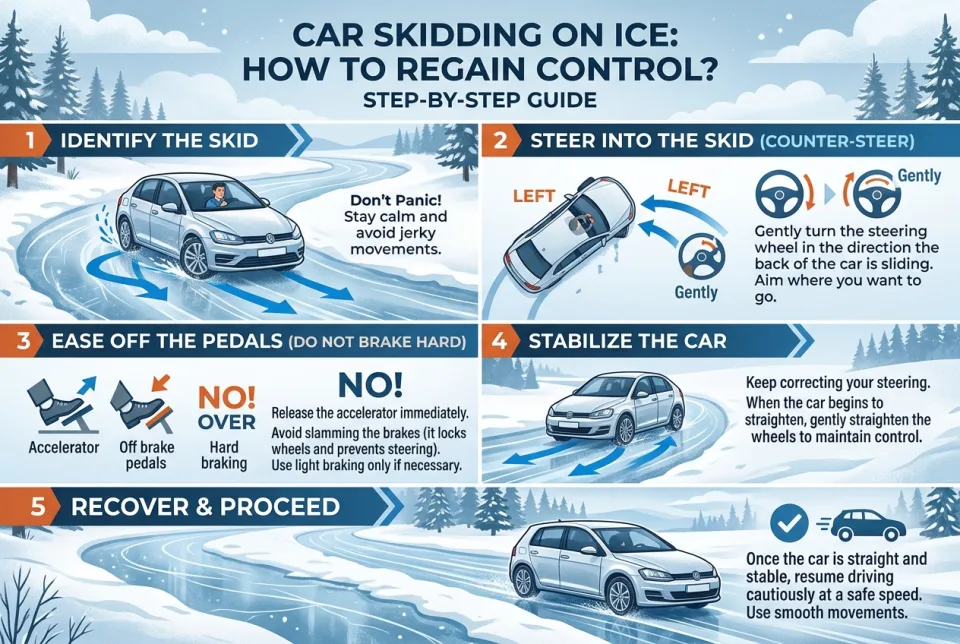
Quick answer
5 steps — read this before anything else
-
1
Stay calm and look where you want to go.
-
2
Ease off the accelerator and avoid sudden braking.
-
3
Steer smoothly in the direction you want the front of the car to go.
-
4
If you have anti-lock brakes, apply firm continuous pressure; if not, gently pump the brakes.
-
5
Once the car straightens, gently resume control.
Warning
Skidding on ice can lead to loss of control and serious collisions. Always wear your seatbelt and reduce speed in icy conditions.
Important — please read
This content is general educational and informational only, and is not a substitute for professional medical advice, diagnosis or treatment. Always seek the advice of a qualified health provider with any questions you may have about a medical condition. Never disregard or delay seeking professional medical care because of something you read here. In an emergency or life-threatening situation, call your local emergency services (police, fire or ambulance) immediately.
Skidding on ice can happen in an instant, but the right response can help you regain control and avoid a crash. This guide explains what to do and what not to do when your car starts to slide.
What is happening
A skid occurs when your tires lose traction with the road surface. On ice, even a thin layer can drastically reduce grip, causing the car to slide sideways or continue forward while you steer. There are two main types: understeer (front tires lose grip and the car plows forward) and oversteer (rear tires lose grip and the car spins).
Emergency warning
If you are in immediate danger, call your local emergency services. If the car is uncontrollable and you are heading toward a collision, brace yourself and prepare for impact. Do not attempt to exit a moving vehicle.
What to do first
- Stay calm and look where you want to go. Your hands follow your eyes. Aim for a safe path, not at the obstacle.
- Ease off the accelerator. Lifting off the gas helps transfer weight and allows the tires to regain grip. Do not slam on the brakes.
- Steer smoothly in the direction you want the front of the car to go. For understeer, straighten the wheel slightly to let the front tires regain grip, then steer where you want to go. For oversteer, steer into the skid (turn the wheel in the direction the rear is sliding).
- Brake correctly. If your car has anti-lock brakes (ABS), apply firm, continuous pressure and steer. If you do not have ABS, gently pump the brakes to avoid locking the wheels.
- Once the car straightens, gently resume control. Avoid abrupt inputs that could trigger another skid.
What NOT to do
- Do not slam on the brakes. This can lock the wheels and worsen the skid.
- Do not jerk the steering wheel. Smooth, deliberate inputs are key.
- Do not accelerate. Power to the wheels reduces grip further.
- Do not stare at the hazard. Look at your escape path.
- Do not overcorrect. Once the car straightens, ease off the steering to avoid a skid in the opposite direction.
When to call for help
If you cannot regain control and a collision occurs, or if you end up stuck in a dangerous location (e.g., in the path of traffic), call emergency services immediately. If you are uninjured but stranded, contact roadside assistance or a recovery service.
What to monitor
After a skid, check your surroundings for other vehicles and hazards. Once stopped in a safe place, inspect your tires and vehicle for damage. If you notice any steering or braking issues, have the car checked by a professional before driving further.
How to prevent it
- Reduce speed on ice and snow. Drive smoothly and avoid sudden maneuvers.
- Ensure your tires are properly inflated and have adequate tread. Consider winter tires in cold climates.
- Increase following distance to allow more time to react.
- If conditions are severe, avoid driving unless necessary.
Remember: the best way to handle a skid is to avoid one. Stay alert and adjust your driving to the conditions. This information is general and not a substitute for professional driving instruction or emergency advice. In an emergency, call your local emergency services.
Spotted an error? Report it — we correct factual mistakes promptly.
Read next
Accident in a rental car abroad: what to do?
A step-by-step guide to handling a rental car accident in a foreign country, from securing the scene to notifying the rental company and your insurer.
Put the wrong fuel in the car: what to do?
Putting the wrong fuel in your car can cause serious damage if you start the engine. Here is what to do, what not to do, and how to prevent it.
Car stuck in mud or snow: how to get out?
Being stuck in mud or snow is frustrating but usually manageable. Learn safe, step-by-step techniques to free your vehicle and avoid making the situation worse.
Driving in snow without chains: what to do?
If you must drive in snow without chains, slow down, increase following distance, and use gentle inputs. Learn how to stay safe and when to turn back.
Related handy tools
Checklists, decision guides, scenarios and quizzes for the same situation.