Winter coat under the car seat: the hidden danger
A bulky coat under a car seat can interfere with seat belts and child car seats, and it can become a projectile in a crash. Learn the safe way to handle winter coats in the car.
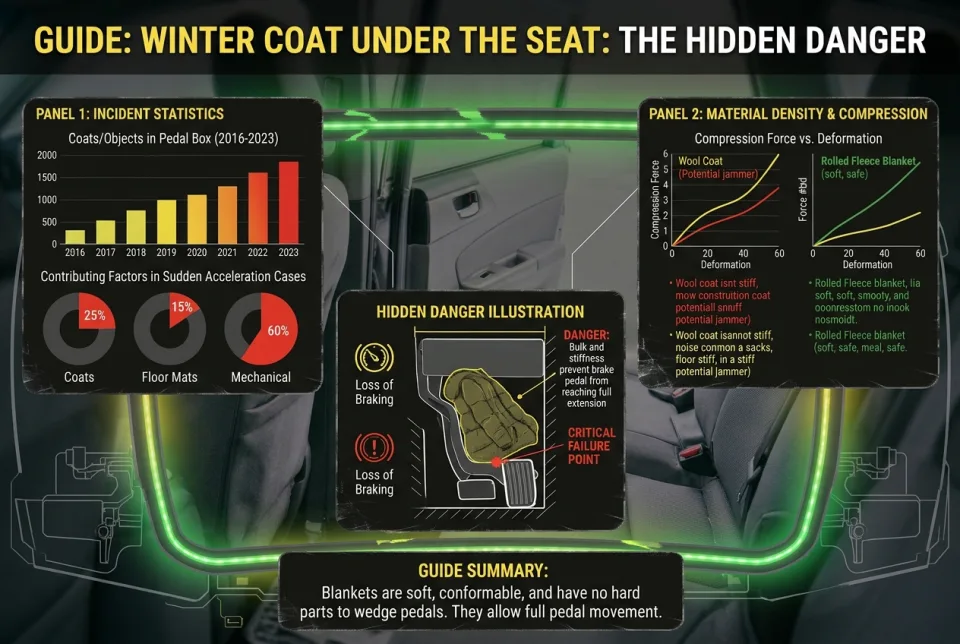
Quick answer
5 steps — read this before anything else
-
1
Remove bulky coats before buckling up, then use the coat as a blanket over the lap after the belt is fastened.
-
2
Never place a coat, blanket, or padding under a child car seat or between the child and the harness.
-
3
Keep loose items, including coats, secured in the cargo area or on the floor, not on seats or under them.
-
4
Check that the seat belt fits snugly against the body with no slack from clothing.
-
5
If a coat must stay in the car, store it in a closed trunk or cargo area, not under a seat.
Warning
Bulky coats under seat belts or car seats can make restraints loose and increase injury risk in a crash. Always remove thick coats before buckling up.
A winter coat tucked under a car seat might seem like a harmless way to keep the car tidy or to give a child a softer ride. In reality, it can create two separate safety problems: it can interfere with how a seat belt or child car seat fits, and it can become a heavy, unsecured object in a crash. Understanding these risks helps you keep everyone in the car safer during cold months.
What is happening
Car seats and seat belts are designed to fit closely against the body. A bulky coat adds inches of compressible material between the occupant and the belt or harness. In a sudden stop or crash, that material can compress, leaving the belt loose and allowing the body to move further than intended. Placing a coat under a child car seat can also lift the seat or create an uneven base, which may affect how the seat sits on the vehicle seat. Separately, any loose object in the passenger area, including a coat, can be thrown around during a crash and cause injuries.
Emergency warning
If you are in a crash or someone is injured, call your local emergency services immediately. Do not move an injured person unless there is immediate danger. This guide is about prevention, not crash response.
What to do first
- Remove bulky coats before buckling up. Have everyone take off thick winter coats and place them aside. Thin layers are fine as long as the belt fits snugly.
- Buckle up, then add warmth. Fasten the seat belt or child car seat harness first, then drape the coat over the person like a blanket, or put the coat on backwards over the fastened belt.
- Check the fit. The belt should lie flat against the body with no slack. For a child car seat, you should not be able to pinch excess harness strap at the shoulder.
- Secure loose coats. Store extra coats in the trunk or cargo area, or on the floor if they cannot roll under the pedals. Never place them under a seat or on top of a car seat.
What NOT to do
- Do not put a coat, blanket, or cushion under a child car seat or between the child and the harness.
- Do not let anyone wear a bulky coat under a seat belt or harness and assume it is safe.
- Do not leave loose, heavy items on passenger seats or in the footwell where they can slide under the brake or accelerator pedals.
- Do not use aftermarket car seat inserts or padding that did not come with the seat unless the seat manufacturer explicitly allows it.
When to seek professional help
If you are unsure whether your child car seat is installed correctly, look for a local child passenger safety technician or inspection station. Many fire departments and hospitals offer free checks. If you have been in a crash, have the car seat inspected or replaced according to the manufacturer's guidance, and seek medical care for anyone with symptoms.
How to prevent it
- Keep a lightweight blanket in the car for warmth instead of relying on bulky coats.
- Make removing coats part of the boarding routine for every trip.
- Store coats in the trunk or cargo area, and use cargo nets or organizers to keep items from sliding.
- Regularly check that the car seat is tight and the harness fits snugly against your child's body.
Next time you get in the car, take a moment to remove bulky coats, buckle up, and then add warmth. It is a small habit that can make a real difference.
This is general safety information, not a substitute for professional advice. In an emergency, call your local emergency services.
Sources & references
Spotted an error? Report it — we correct factual mistakes promptly.
Read next
What to Do If You Suspect a Miscarriage
A miscarriage requires prompt medical evaluation and gentle physical and emotional care. Learn the immediate steps to take and when to seek urgent emergency assistance.
Building an emergency backpack for school kids
A practical, age-appropriate emergency kit for school children that covers basic needs, comfort, and communication without unnecessary bulk.
Nightmares versus night terrors in children
Nightmares and night terrors are different sleep events with different responses. Learn how to tell them apart and what to do safely.
What age can kids stay home alone legally?
There is no single legal age for leaving a child home alone in most places. The law focuses on whether the child is mature enough and the situation is safe.
Related handy tools
Checklists, decision guides, scenarios and quizzes for the same situation.