Toddler swallowed a button battery: what to do?
A swallowed button battery is a medical emergency that can cause severe internal burns within about two hours. Act immediately: do not wait for symptoms and do not try to make your child vomit.
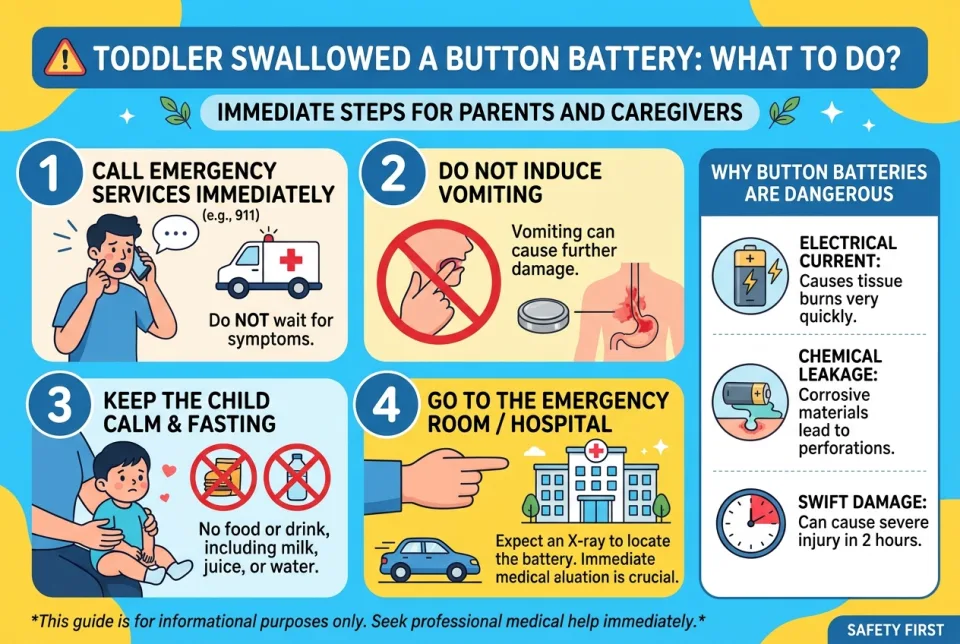
Quick answer
5 steps — read this before anything else
-
1
Call your local emergency services or poison control right now, even if your child seems fine.
-
2
Do not make your child vomit, and do not give food, drink or home remedies to 'flush it out'.
-
3
If your child is over 1 year old and can swallow and breathe normally, some poison centers advise giving 2 teaspoons of honey while you travel, only on their instruction.
-
4
Go to the nearest emergency department immediately; do not wait at home for symptoms.
-
5
Bring the device or matching battery packaging so staff know the size and type.
Warning
A swallowed button battery can cause severe internal burns within about two hours. Call emergency services or poison control and go to the emergency department immediately, even if your child seems well. Do not make your child vomit.
Important — please read
This content is general educational and informational only, and is not a substitute for professional medical advice, diagnosis or treatment. Always seek the advice of a qualified health provider with any questions you may have about a medical condition. Never disregard or delay seeking professional medical care because of something you read here. In an emergency or life-threatening situation, call your local emergency services (police, fire or ambulance) immediately.
A button or coin battery is one of the most dangerous objects a toddler can swallow. When it lodges in the food pipe (esophagus), the battery creates an electrical current that can cause serious chemical burns in as little as two hours. This is a time-critical emergency. Your child's calm behavior or lack of symptoms does not mean they are safe.
Emergency warning
Call your local emergency services or a poison control center immediately. Do not wait for symptoms such as drooling, vomiting, pain or refusal to eat. If you are unsure whether a battery was swallowed, treat it as if it was and get advice now.
What to do first
- Call for help now. Contact emergency services or your regional poison control center. Tell them your child's age, the battery size if you know it, and the time you think it was swallowed.
- Stop your child from eating or drinking unless a medical professional tells you otherwise. Do not give food, drink or home remedies to try to move the battery along.
- Go to the nearest emergency department immediately. Do not wait at home to see if the battery passes on its own.
- Bring evidence. Take the device the battery came from, the empty packaging, or a matching battery so staff can identify the size and type.
- Keep your child upright and calm during travel and watch their breathing.
About the honey advice
Some poison control centers advise giving a small amount of honey on the way to hospital, but only for children over 1 year old who can swallow and breathe normally, and only when a professional tells you to. Never give honey to a baby under 1 year old. Never delay travel to give it.
What NOT to do
- Do not make your child vomit. Vomiting can move the battery and cause more damage.
- Do not wait for symptoms. Serious burns can develop before any signs appear.
- Do not try to remove the battery with your fingers if it is out of reach.
- Do not assume a small battery will pass safely. Batteries 20 mm across, common coin-size cells, are the most dangerous.
- Do not give honey to a child under 1 year old.
When to call for help
Call emergency services immediately if your child has trouble breathing, is drooling heavily, has chest or throat pain, is vomiting, has blood in their stool, or has swallowed a battery of any size. If you suspect a battery is stuck in the nose or ear, this is also an emergency: go to the emergency department without trying to remove it yourself.
What to monitor
While waiting for or traveling to care, watch for worsening breathing, drooling, gagging, sudden pain, vomiting or unusual sleepiness. Report any change to the medical team.
How to prevent it
- Keep loose batteries, remote controls, key fobs, toys, hearing aids and small electronics out of reach and secured with tape or screws.
- Check that battery compartments are locked or screwed shut.
- Store spare batteries in a closed container well above a toddler's reach.
- Search floors and low surfaces for dropped batteries after changing any device.
Act now: call emergency services or poison control and go to the nearest emergency department. Fast action is the single most important thing you can do. This guide is general information and is not a substitute for professional medical advice. In an emergency, call your local emergency number.
Sources & references
Spotted an error? Report it — we correct factual mistakes promptly.
Frequently asked questions
Read next
What to Do If Your Water Breaks Early
If your water breaks before 37 weeks or before labor begins, immediately contact your midwife or emergency services and follow essential safety steps.
What age can kids stay home alone legally?
There is no single legal age for leaving a child home alone in most places. The law focuses on whether the child is mature enough and the situation is safe.
Signs of a broken arm in a child: what to do?
Learn how to recognize a possible broken arm in a child, provide safe first aid, and know when to seek emergency care.
Child got sunburnt: what to do?
Sunburn in children needs prompt cooling, fluids and pain relief, plus watching for signs of heat illness. Learn the safe steps and when to get medical help.
Related handy tools
Checklists, decision guides, scenarios and quizzes for the same situation.