Trailer starts swaying while towing: what to do?
Trailer sway can quickly become dangerous. Learn the correct immediate response and how to prevent it from happening again.
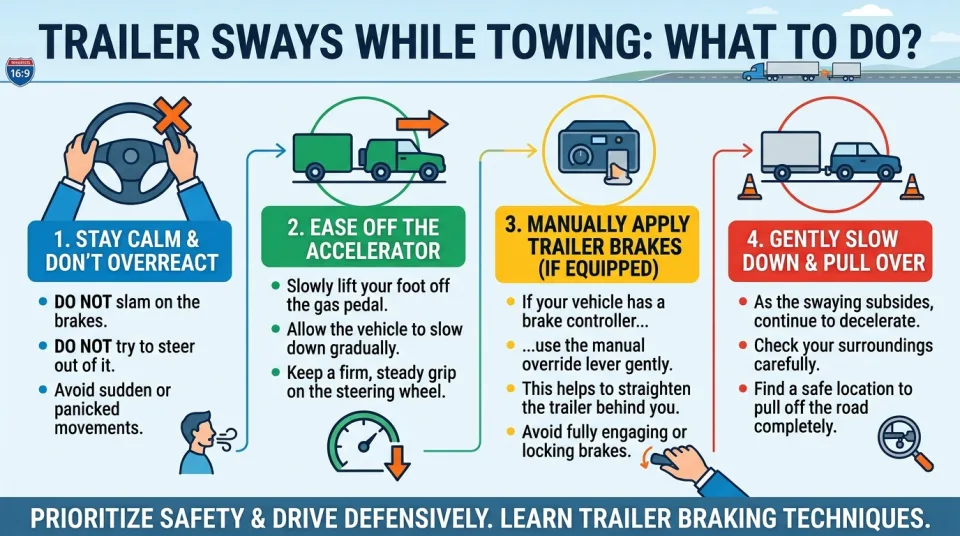
Quick answer
4 steps — read this before anything else
-
1
Ease off the accelerator gradually and avoid braking hard.
-
2
Keep the steering wheel steady and look ahead.
-
3
If sway persists, pull over safely and check your load and hitch.
-
4
Never accelerate to try to stop the sway.
Warning
Trailer sway can lead to loss of control and rollover. Never brake hard or accelerate to try to stop sway, as this can make it worse.
Trailer sway, also called fishtailing, happens when the trailer oscillates side to side behind your vehicle. It can escalate quickly and cause loss of control, so knowing the right response is essential.
What is happening
Sway often starts when the trailer is overloaded at the rear, the weight is distributed unevenly, the hitch is too high, or you are driving too fast for conditions. Crosswinds, passing trucks, and sudden steering inputs can trigger it.
Emergency warning
If the sway becomes severe and you cannot control the vehicle, call local emergency services immediately. Do not wait until you are in a dangerous situation.
What to do first
- Ease off the accelerator. Gradually reduce speed by lifting your foot, not by braking hard. Hard braking can make the sway worse.
- Keep the steering wheel steady. Hold it firmly and avoid quick corrections. Look straight ahead and keep the vehicle pointed in your lane.
- Do not accelerate. Speeding up might feel like it stabilizes the trailer, but it usually makes sway more violent.
- If you have a trailer brake controller, apply the trailer brakes only. This can help straighten the trailer. Do not use the tow vehicle's brakes alone.
- Pull over safely. Once the sway is under control, slow down and stop in a safe place. Check the hitch, safety chains, tire pressure, and load distribution.
What NOT to do
- Do not slam on the brakes.
- Do not jerk the steering wheel to correct the sway.
- Do not accelerate to try to outrun the sway.
- Do not continue driving if the sway keeps happening.
When to call for help
Call emergency services if the sway causes you to leave your lane, if you cannot regain control, or if there is a collision. If the trailer is unsafe to tow, call a professional towing service.
What to monitor
After you stop, inspect the tires for damage or low pressure, check that the hitch is secure, and confirm the load is balanced with more weight toward the front of the trailer. Also check that the trailer is level with the tow vehicle.
How to prevent it
- Load the trailer with about 60% of the weight ahead of the axle and 40% behind it, and keep the tongue weight within the manufacturer's specified range.
- Use a weight-distribution hitch if your setup requires it.
- Keep tires properly inflated and in good condition.
- Drive at a safe speed for conditions, especially in crosswinds or when passing large vehicles.
- Practice smooth steering and braking inputs.
If sway happens, stay calm, ease off the gas, and keep the steering steady. After you are safe, address the cause before continuing your trip.
This is general information and not a substitute for professional driving advice. In an emergency, call local emergency services.
Spotted an error? Report it — we correct factual mistakes promptly.
Read next
What Should You Do If Your Car Shakes While Driving?
A shaking car can signal anything from a minor tire issue to a dangerous mechanical failure. Learn how to respond safely and what to check.
Exhaust smoke colors: what do they mean?
The color of your vehicle's exhaust smoke can indicate engine problems. Learn what white, blue, and black smoke mean and when to seek professional help.
Accident in a rental car abroad: what to do?
A step-by-step guide to handling a rental car accident in a foreign country, from securing the scene to notifying the rental company and your insurer.
Windshield wipers stopped working in the rain: what to do?
When wipers fail in the rain, your visibility can vanish in seconds. Learn how to react safely, get off the road, and prevent this from happening again.
Related handy tools
Checklists, decision guides, scenarios and quizzes for the same situation.