Child got sunburnt: what to do?
Sunburn in children needs prompt cooling, fluids and pain relief, plus watching for signs of heat illness. Learn the safe steps and when to get medical help.
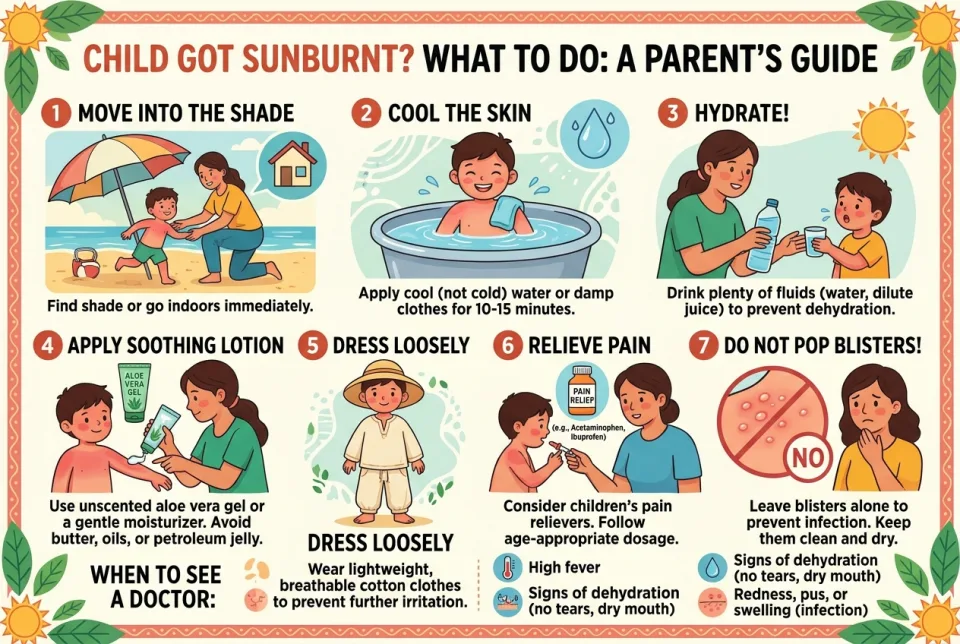
Quick answer
5 steps — read this before anything else
-
1
Move your child out of the sun into a cool, shaded or indoor space immediately.
-
2
Cool the skin with a cool (not icy) bath or cool damp cloths for 10-20 minutes, then pat dry gently.
-
3
Give plenty of fluids and offer appropriate pain relief as advised by a pharmacist or doctor.
-
4
Keep the burnt skin covered loosely and out of the sun until fully healed.
-
5
Seek urgent medical help if there is blistering over a large area, severe pain, confusion, vomiting or signs of dehydration.
Warning
Call emergency services immediately if sunburn is accompanied by confusion, fainting, repeated vomiting, severe headache or unusual drowsiness, as these can be signs of heatstroke.
Important — please read
This content is general educational and informational only, and is not a substitute for professional medical advice, diagnosis or treatment. Always seek the advice of a qualified health provider with any questions you may have about a medical condition. Never disregard or delay seeking professional medical care because of something you read here. In an emergency or life-threatening situation, call your local emergency services (police, fire or ambulance) immediately.
Sunburn is skin damage caused by ultraviolet (UV) radiation. A child's skin is thinner and more sensitive than an adult's, so sunburn can happen faster and be more serious. Most mild sunburn can be managed at home, but some cases need medical attention, and sunburn in a baby or young child should always be taken seriously.
Emergency warning
Call your local emergency services immediately if your child has sunburn plus any of these signs: confusion, unusual sleepiness or difficulty waking, a severe headache, repeated vomiting, dizziness or fainting, very fast breathing or heartbeat, or skin that looks pale, clammy or mottled. These can signal heat exhaustion or heatstroke, which is a medical emergency.
What to do first
- Get out of the sun. Move your child to a cool, shaded or indoor space straight away.
- Cool the skin. Give a cool (not icy) bath or apply cool, damp cloths to the burnt areas for 10 to 20 minutes. Do not use ice, frozen packs or ice-cold water directly on the skin.
- Pat dry gently and leave the skin slightly damp. Do not rub.
- Replace fluids. Offer frequent small drinks of water or an oral rehydration solution. Breastfeed or formula-feed babies as normal.
- Ease the pain. Ask a pharmacist or doctor about suitable pain relief for your child's age and weight. Never give aspirin to a child.
- Protect the skin. Keep burnt areas covered loosely with cool, breathable clothing and keep your child out of direct sun until the skin has fully healed.
What NOT to do
- Do not apply ice, frozen packs or ice-cold water: this can further damage the skin.
- Do not pop blisters. Blisters are a natural protective barrier and popping them risks infection.
- Do not apply butter, oils, toothpaste, vinegar or home remedies. They trap heat and can irritate the skin.
- Do not use petroleum jelly or heavy creams on fresh burns.
- Do not let your child go back into the sun, and do not use tanning products or sunbeds.
- Do not give aspirin to a child.
When to seek professional care
Contact a doctor, urgent care service or your local health advice line if:
- Your child is a baby or very young infant with any sunburn.
- Blisters form, especially over a large area or on the face, hands or genitals.
- The skin is very painful, swollen or looks infected (increasing redness, warmth, pus or fever).
- Your child seems unwell, is not drinking, has fewer wet nappies or urinates less than usual, or has a dry mouth.
- The sunburn covers a large part of the body.
- There is no improvement after a few days.
What to monitor
Watch for signs of dehydration (dry mouth, dark urine, fewer wet nappies, drowsiness) and for heat illness (headache, nausea, dizziness, confusion). Check the burnt skin daily for increasing redness, swelling, pus or fever, which can indicate infection. Mild sunburn usually peaks within 12 to 24 hours and starts to ease after a few days.
How to prevent it
Keep babies under 6 months out of direct sunlight. For older children, use shade, protective clothing, a wide-brimmed hat and sunglasses, and apply broad-spectrum sunscreen with a high SPF to exposed skin, reapplying regularly and after swimming or sweating. Avoid the sun during the middle of the day when UV is strongest, and remember that UV can still cause harm on cloudy days.
If your child is uncomfortable, in pain or showing any warning signs, seek medical advice rather than waiting. This is general information and not a substitute for professional medical advice. In an emergency, call your local emergency services.
Sources & references
Spotted an error? Report it — we correct factual mistakes promptly.
Read next
What Should You Do If Your Child Is Refused Entry to School Because of Missing Documents?
If your child is turned away from school because of missing paperwork, stay calm and act quickly. This guide explains how to resolve the issue and get your child enrolled.
What Should I Consider When Comparing an Only Child vs. a Large Family?
There is no single best family size. Research shows that family dynamics, resources, and parenting quality matter far more than the number of siblings.
What to Do If Your Water Breaks Early
If your water breaks before 37 weeks or before labor begins, immediately contact your midwife or emergency services and follow essential safety steps.
What to Do in Case of Premature Labor
Premature labor occurs when contractions begin before 37 weeks of pregnancy. Learn the critical signs and immediate safety steps to take.
Related handy tools
Checklists, decision guides, scenarios and quizzes for the same situation.