Identity documents needed for a new job: what to do?
Starting a new job often means proving who you are and your right to work. Here is how to prepare your documents, what to expect, and how to handle common problems.
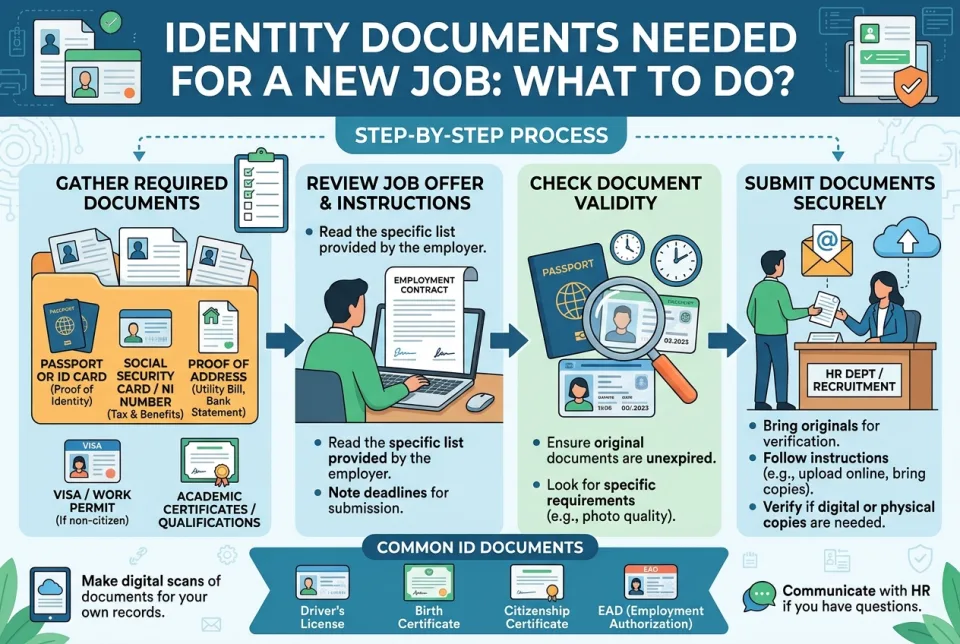
Quick answer
5 steps — read this before anything else
-
1
Ask your employer exactly which documents they need and in what form (original, copy, or digital).
-
2
Gather your primary ID (passport or national ID card) and any work authorization or tax forms they request.
-
3
Check that names match across documents and that nothing is expired.
-
4
Keep photocopies or secure digital scans, and never hand over originals unless required.
-
5
If a document is missing or expired, tell your employer early and ask about alternatives or a deadline extension.
Starting a new job usually involves proving your identity and your right to work. Requirements vary by country and employer, so the first step is always to ask your new employer for their exact list. This guide covers common documents, how to prepare them, and what to do if something is missing.
What is happening
Employers are legally required in many countries to verify that you are who you say you are and that you are allowed to work. This is not a sign of distrust: it is a standard part of hiring. The check may happen before your first day or during onboarding.
Step by step: preparing your documents
- Ask for the exact list. Request the employer's document checklist in writing, including whether they need originals, copies, or a digital upload.
- Gather primary ID. A passport or national identity card is the most widely accepted. Check the expiry date: many employers will not accept an expired document.
- Prepare work authorization evidence if you are not a citizen of the country where you will work. This could be a visa, work permit, residence card, or similar. Ask your employer which specific document they accept.
- Collect tax or social security forms if requested. These are often needed for payroll, not for identity itself, but they are commonly part of the same onboarding pack.
- Check name consistency. If your name appears differently across documents (for example, after marriage or a legal name change), bring the supporting document that explains the difference, such as a marriage certificate or name change deed.
- Make copies and store them securely. Keep a photocopy or encrypted digital scan of each document. Do not email unencrypted scans unless your employer's system is secure.
- Bring originals only if required. If you must show originals, keep them with you and ask for them back immediately after verification. Never leave originals with an employer unless there is a clear legal reason.
What NOT to do
- Do not hand over original documents and leave them behind without a receipt or a clear return date.
- Do not send high-resolution scans of your ID over unencrypted email or messaging apps.
- Do not use a document you know is expired, altered, or not yours. This can end your job offer and may be illegal.
- Do not pay anyone to "fast-track" a work permit or ID check. Legitimate employers do not ask you to pay for your own verification.
- Do not ignore a request for documents. Silence can delay your start date or cause the offer to be withdrawn.
If a document is missing or expired
Tell your employer as soon as you know. Ask whether they accept an alternative document, a receipt showing a renewal is in progress, or a short extension. In many places, a combination of documents can satisfy the check even if one is unavailable. Get any agreement in writing.
When to get professional help
If you are unsure whether you have the legal right to work, or if your employer is asking for documents that seem unusual, seek advice from a qualified immigration adviser or a local workers' rights organization. Do not rely on informal advice from friends or online forums for legal questions.
How to prevent problems
- Check expiry dates on your ID and passport well before you job hunt.
- Keep a secure folder (physical or encrypted digital) with copies of your key documents.
- Ask for the document checklist at the offer stage, not on your first day.
Your next step: contact your new employer today and ask for their written document checklist, then check each item against your folder.
Spotted an error? Report it — we correct factual mistakes promptly.
Read next
Pet travel documents for going abroad: what to do?
Taking a pet abroad requires careful planning and specific documents. Start early, check the destination's rules, and ensure your pet meets all health requirements.
Renewing immigration documents late: what to do?
If you missed a renewal deadline for a visa, permit, or green card, act quickly. File as soon as possible, gather evidence of your situation, and consider consulting an immigration attorney. Do not assume you can fix it later.
Harassment at work: what to do?
Workplace harassment is illegal in many countries. Learn the practical steps to document incidents, report safely, and protect your rights.
Laptop with work data lost: what to do?
If your work laptop is lost or stolen, act quickly to protect company data and meet your reporting obligations. Here is a step-by-step guide to secure accounts, report the loss, and minimize damage.
Related handy tools
Checklists, decision guides, scenarios and quizzes for the same situation.