Car battery dead in winter: what to do?
A dead battery in cold weather is common. Learn safe steps to jump-start or replace it, and how to prevent it from happening again.
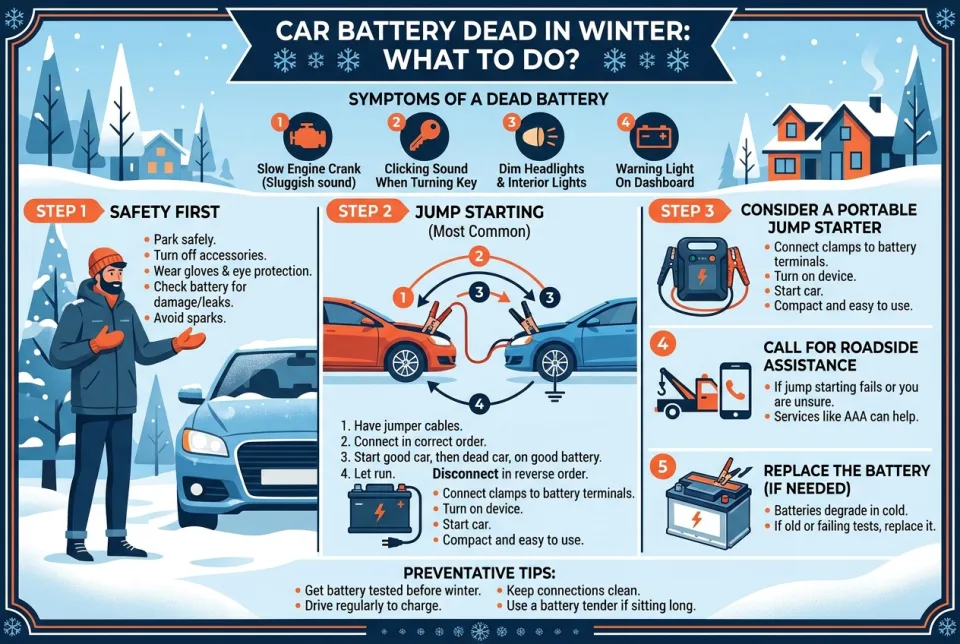
Quick answer
4 steps — read this before anything else
-
1
Check for obvious issues like lights left on or loose terminals.
-
2
If you have jumper cables and a helper, jump-start safely following the correct order.
-
3
If jump-starting fails or the battery is old, replace it.
-
4
In extreme cold, keep the battery warm and avoid unnecessary electrical loads.
Warning
Never jump-start a battery that is frozen, cracked, or leaking. It can explode. Do not smoke or use open flames near a battery.
A dead car battery in winter is a common problem: cold temperatures reduce a battery's ability to hold a charge and increase the power needed to start the engine. This guide explains what to do safely, whether you can jump-start, and how to prevent it from happening again.
What is happening
Car batteries rely on a chemical reaction that slows down in cold weather. At 0°F (-18°C), a battery can lose about half its cranking power. If the battery is old or already weak, the cold can push it over the edge. Common signs include slow engine cranking, dim lights, or a clicking sound when you turn the key.
What to do first
- Stay safe: Turn off the engine and all accessories. Put the car in park (or neutral with parking brake) and turn on hazard lights if you are on the road.
- Check for simple causes: Look for interior lights left on, a glove box ajar, or loose battery terminals. If terminals are corroded, clean them (wear eye protection) and tighten.
- Assess the battery: If the battery is more than 3-5 years old or shows signs of swelling, cracking, or leaking, do not attempt to jump-start. Replace it.
- Jump-start safely (if you have cables and a helper): Follow the correct order to avoid sparks: connect red (positive) to the dead battery's positive terminal, then red to the good battery's positive, then black (negative) to the good battery's negative, and finally black to a metal ground on the dead car (not the battery). Start the good car, then the dead car. Once running, remove cables in reverse order.
- If jump-starting fails: The battery may be beyond charging. Call a roadside service or replace the battery.
What NOT to do
- Do not attempt to jump-start a battery that is frozen, cracked, or leaking. It can explode.
- Do not connect the negative cable to the dead battery's negative terminal; use a ground point instead.
- Do not smoke or use open flames near the battery; it produces explosive hydrogen gas.
- Do not try to push-start a car with an automatic transmission.
When to call for help
Call a professional if you are unsure about jump-starting, if the battery is damaged, or if the car does not start after a jump. In extreme cold, if you are stranded and cannot stay warm, call emergency services.
What to monitor
After a jump-start, drive the car for at least 20-30 minutes to recharge the battery. If the battery dies again soon, have the charging system (alternator) and battery tested. A battery that repeatedly dies in cold weather likely needs replacement.
How to prevent it
- Test your battery before winter starts; replace if it is older than 4-5 years.
- Keep battery terminals clean and tight.
- Park in a garage or use a battery blanket in extreme cold.
- Avoid short trips that do not allow the battery to fully recharge.
- Turn off lights, radio, and accessories before shutting off the engine.
If your battery dies in winter, stay calm, assess safety, and jump-start only if it is safe to do so. When in doubt, call a professional. Regular battery checks before winter can save you from a cold-weather breakdown.
Sources & references
Spotted an error? Report it — we correct factual mistakes promptly.
Read next
Key locked inside the car: what to do?
Stay calm, check all doors, and call a professional locksmith or roadside service. Avoid breaking windows unless there is an emergency.
Accident in a rental car abroad: what to do?
A step-by-step guide to handling a rental car accident in a foreign country, from securing the scene to notifying the rental company and your insurer.
Key fob battery dead: how to start the car?
When your key fob battery dies, you can often still start your car using the hidden key or backup slot. Learn the steps to get moving again.
Brake failure while driving: what to do?
Brake failure at speed is a true emergency. Stay calm, pump the pedal, downshift, and use the handbrake or road friction to slow down safely.
Related handy tools
Checklists, decision guides, scenarios and quizzes for the same situation.