Sick leave: knowing your rights
Understand your legal rights to sick leave, from notification and documentation to pay and protection from retaliation. Learn how to navigate common scenarios and where to get help.
Quick answer
5 steps — read this before anything else
-
1
Check your employment contract, company handbook, and local labor laws for sick leave policies.
-
2
Notify your employer as soon as possible, following the required call-in procedure.
-
3
Provide a doctor's note only if your employer requests it and it is allowed by law.
-
4
Keep records of all communications and medical documentation.
-
5
Contact a labor lawyer or workers' rights organization if you face retaliation or unpaid leave.
Important — please read
This content is general educational and informational only, and is not a substitute for professional medical advice, diagnosis or treatment. Always seek the advice of a qualified health provider with any questions you may have about a medical condition. Never disregard or delay seeking professional medical care because of something you read here. In an emergency or life-threatening situation, call your local emergency services (police, fire or ambulance) immediately.
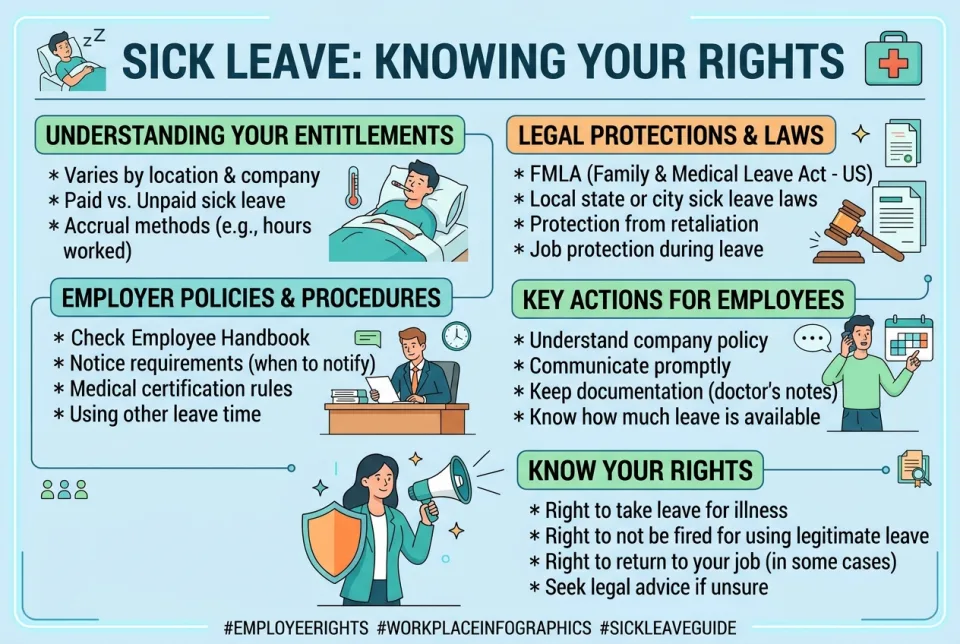
When you are too ill to work, knowing your rights can reduce stress and help you protect your job and income. Sick leave laws vary widely by country, state, and even city, so this guide outlines general principles and steps to find the rules that apply to you.
What is happening
Sick leave is time off work for illness, injury, or medical appointments. In many places, employment laws or contracts set minimum standards for paid or unpaid sick leave, notice requirements, and protection from unfair dismissal. Your specific rights depend on your location, your employment status (full-time, part-time, temporary), and your employer's policies.
Step by step: what to do when you need sick leave
- Review your rights and policies. Check your employment contract, employee handbook, and any collective agreement. Look for terms on sick leave, notification, medical certificates, and pay. Also search for your country or region's labor laws on sick leave (for example, statutory sick pay or protected sick leave).
- Notify your employer promptly. Follow the call-in procedure exactly: who to contact, how (phone, email, app), and by when. If you cannot call yourself, ask someone to do it for you. Be clear about your condition and expected return date, but you do not have to share detailed medical information unless required.
- Provide documentation if required. Some employers require a doctor's note for absences beyond a certain length. Only provide what is legally required and keep a copy. In many places, employers cannot demand a diagnosis, only confirmation that you are unfit for work.
- Track your leave and pay. Record dates, hours missed, and any sick pay received. If your pay is incorrect or missing, raise it with your employer in writing and keep a copy.
- Know your return-to-work rights. After sick leave, you may be entitled to return to the same or an equivalent role. If you need accommodations (e.g., phased return, modified duties), discuss them with your employer and, if necessary, get medical advice.
What NOT to do
- Do not ignore your employer's notification rules. Failing to call in as required can jeopardize your leave or pay, even if you are genuinely ill.
- Do not share more medical information than necessary. You are generally not obligated to disclose a diagnosis, only your fitness for work.
- Do not assume you have no rights. Even if your employer says there is no paid sick leave, local law may provide minimum protections.
- Do not sign anything you do not understand. If your employer asks you to sign a waiver or agreement about your sick leave, seek advice first.
When to seek professional help
If you are dismissed, disciplined, or denied pay because of legitimate sick leave, or if your employer demands unreasonable documentation, consult a labor lawyer, a union representative, or a workers' rights organization. In many countries, free legal advice is available through government labor departments or nonprofit groups.
How to protect yourself
- Keep written records of all communications about your sick leave.
- Know your company's policy and the local legal minimums before you need them.
- Ask for written confirmation of any agreements about pay or return to work.
Your next step: check your contract and local labor law today, so you are prepared if illness strikes. This is general information, not legal advice; for your specific situation, consult a qualified professional.
Spotted an error? Report it — we correct factual mistakes promptly.
Read next
What Should You Do If You Feel Burned Out by Your Workload?
Feeling burned out by your workload is common, but it is not something you have to accept. Learn 10 practical ways to set better boundaries and protect your energy.
What to Do If Your CV Gets Rejected
Having your CV or resume rejected can be discouraging, but it provides an opportunity to optimize your strategy. Learn how to analyze feedback and refine your job applications.
What to Do If Nobody Responds to Your Job Applications
If your job applications are getting zero responses, audit your strategy to unblock your search. Learn how to optimize your resume, tailor your outreach, and target hidden opportunities.
Gig economy workers: knowing your protections
Gig workers often fall outside traditional employment protections. Learn what rights may apply, how to check your status, and where to get help.
Related handy tools
Checklists, decision guides, scenarios and quizzes for the same situation.