Pet left in a hot parked car: what to do?
A parked car can reach dangerous temperatures within minutes, even on mild days. Here is how to assess the situation, get the animal help, and avoid making things worse.
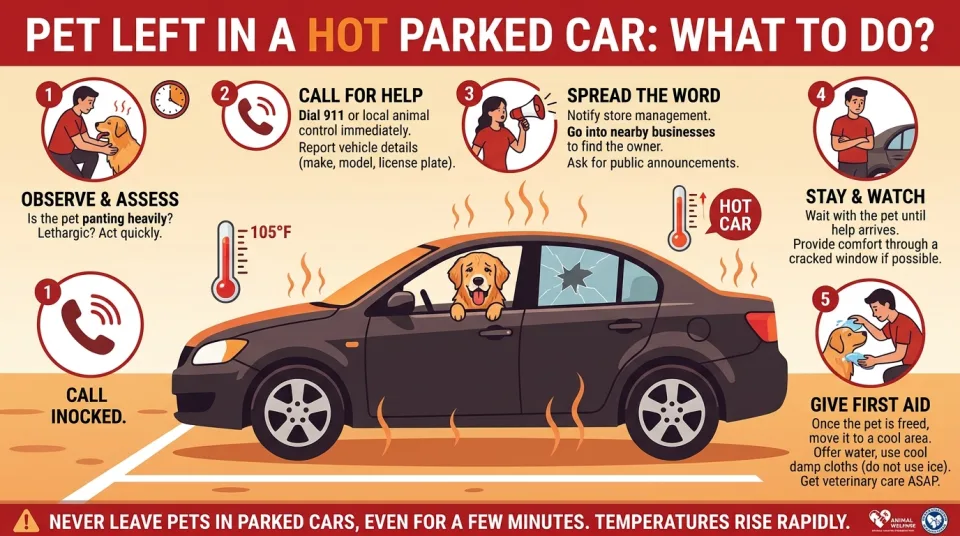
Quick answer
5 steps — read this before anything else
-
1
Note the car's location, make, model and plate, and the time.
-
2
Check whether the animal is showing distress: heavy panting, drooling, weakness, collapse.
-
3
Call local emergency services or animal control right away if the animal is in distress.
-
4
Try to find the owner through nearby shops or a public address announcement.
-
5
Stay with the car until help arrives and keep a record of what you saw.
Warning
Heatstroke in pets can be fatal within minutes. If an animal in a hot car is panting heavily, drooling, weak or collapsed, call local emergency services or animal control immediately. Do not break windows or remove the animal yourself unless authorities direct you or there is no safer option.
Important — please read
This content is general educational and informational only, and is not a substitute for professional medical advice, diagnosis or treatment. Always seek the advice of a qualified health provider with any questions you may have about a medical condition. Never disregard or delay seeking professional medical care because of something you read here. In an emergency or life-threatening situation, call your local emergency services (police, fire or ambulance) immediately.
On a warm day, the inside of a parked car can become far hotter than the outside air in a very short time. Dogs and other pets cannot cool themselves as efficiently as humans, so heat builds up in their bodies quickly. Even a car parked in the shade with windows slightly open can become dangerous. If you find a pet alone in a hot car, act calmly and quickly.
Emergency warning
If the animal is panting heavily, drooling, vomiting, weak, unsteady or collapsed, treat it as an emergency and call your local emergency services or animal control immediately. Do not wait to see if the owner returns. Give the dispatcher the exact location, the car's make, model, colour and plate number, and describe the animal's condition.
What to do first
- Assess the animal from outside. Look for distress signs: frantic panting, thick drooling, glazed eyes, lying flat, vomiting, trembling or no response. A calm dog lying quietly is still at risk, so do not assume it is fine.
- Record the details. Note the time, the car's location, plate number and the animal's condition. Photos or video can help authorities and the owner understand what happened.
- Call for help. Contact local emergency services or animal control. Many areas treat an animal in a hot car as an urgent welfare matter. Tell them clearly that a pet is locked in a hot vehicle and whether it appears to be in distress.
- Try to locate the owner. Ask staff in nearby shops, a car park office or a security guard to make an announcement. Note that in some places staff may be able to help contact the owner.
- Stay nearby. Remain with the car until help arrives so you can guide responders and report any change in the animal's condition.
What NOT to do
- Do not break a window unless the animal's life is clearly in immediate danger and you have no safer option. Breaking glass can injure the animal and may have legal consequences. Follow the instructions of emergency services or animal control.
- Do not open the car and take the animal out yourself unless directed by authorities. An frightened or overheated animal may bite, and moving it wrongly can cause harm.
- Do not pour ice-cold water over the animal or force it to drink. Rapid cooling and choking risks can make things worse. Leave cooling to the professionals.
- Do not leave the scene assuming someone else will deal with it.
When to call for help
Call immediately if the animal shows any sign of heat distress, if the outside temperature is high, if the car is in direct sun, or if you cannot find the owner within a few minutes. If the animal appears calm but the car is hot, still call animal control or a non-emergency line for advice and keep watching.
How to prevent it
Never leave a pet in a parked car, even briefly, even with windows cracked and even in the shade. If you are travelling with a pet, plan stops where the animal can come with you, or leave it at home in hot weather. If you see someone about to leave a pet in a car, politely point out the risk before they walk away.
Your next step: if a pet is in a hot car right now, note the details, call local emergency services or animal control, and stay with the vehicle until help arrives.
This is general information, not a substitute for professional veterinary advice. In an emergency, call your local emergency services or a veterinarian immediately.
Sources & references
Spotted an error? Report it — we correct factual mistakes promptly.
Read next
What should you do after a car accident?
A step-by-step guide to staying safe, getting help, and handling the aftermath of a car accident, from securing the scene to exchanging information.
Car breakdown on a Moroccan highway: what to do?
A breakdown on a Moroccan highway can be stressful, but following a few key steps will keep you safe and get you help quickly. Here is what to do.
Child car seat recall notice: what to do?
A recall means your child's car seat may not protect them in a crash. Here is how to check, register, and get a safe replacement or repair.
Blinding sun glare while driving: what to do?
Sudden sun glare can erase your view of the road in seconds. Slow down, protect your eyes, and never stop in a live lane to wait it out.
Related handy tools
Checklists, decision guides, scenarios and quizzes for the same situation.