Disputes over a joint account with a partner: what to do?
A joint bank account can become a source of conflict when a relationship ends or trust breaks down. Learn practical steps to protect your money and resolve disputes.
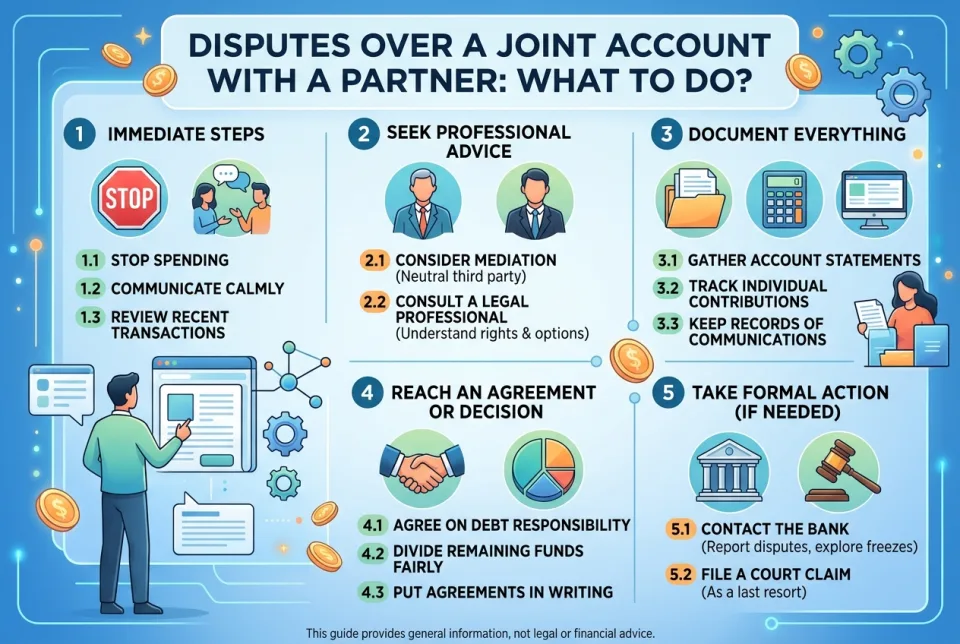
Quick answer
4 steps — read this before anything else
-
1
Stop using the joint account for new deposits and switch your income to a sole account.
-
2
Gather statements and records to understand the balance and recent transactions.
-
3
Contact the bank to ask about freezing the account or removing your name, and follow their process.
-
4
Seek legal advice if the dispute involves significant sums or cannot be resolved amicably.
Important — please read
This content is general educational and informational only, and is not a substitute for professional medical advice, diagnosis or treatment. Always seek the advice of a qualified health provider with any questions you may have about a medical condition. Never disregard or delay seeking professional medical care because of something you read here. In an emergency or life-threatening situation, call your local emergency services (police, fire or ambulance) immediately.
A joint bank account is convenient for shared expenses, but when a relationship breaks down or disagreements arise, it can quickly become a source of stress and financial risk. Disputes often involve unequal contributions, unauthorized withdrawals, or one partner refusing to close the account. This guide outlines practical steps to protect your money and resolve the situation.
What is happening
When you open a joint account, you and the other account holder typically have equal access to the funds. This means either of you can withdraw money, make payments, or close the account (depending on the bank's rules). If trust breaks down, one person may empty the account or run up an overdraft, leaving the other liable. Banks usually require both parties' consent to remove a name or close the account, which can complicate matters.
Step by step: what to do first
- Secure your income. Redirect your salary or other deposits to a sole account in your name only. This prevents further money from entering the joint account.
- Gather evidence. Collect bank statements, transaction records, and any written agreements about how the account would be used. Note any unauthorized withdrawals or suspicious activity.
- Contact the bank. Ask about your options: freezing the account (if available), removing your name, or closing it. Be clear about the dispute and follow their formal complaints process if needed.
- Communicate in writing. If safe to do so, send the other person a clear message stating that you want to resolve the account and propose a fair division of the remaining balance. Keep copies of all correspondence.
- Seek mediation or legal advice. For large sums or if the other person is uncooperative, consult a solicitor or a free legal advice service. Mediation can be a cheaper alternative to court.
What NOT to do
- Do not withdraw all the money without agreement, as this may be seen as unfair or even unlawful, and could escalate the dispute.
- Do not ignore overdrafts or debts. Joint debts can affect both parties' credit files; address them promptly.
- Do not close the account unilaterally if the bank requires both signatures; attempting to do so may cause further problems.
- Do not rely on verbal promises. Get any agreement in writing.
When to seek professional help
Consider legal advice if: the amount in dispute is significant, the other person has withdrawn funds without consent, you are being pursued for a debt you did not authorise, or the bank is unresponsive. In some countries, free advice is available from citizen advice bureaus or consumer protection agencies.
How to prevent future disputes
- Keep joint accounts for shared bills only, and maintain separate accounts for personal savings.
- Agree in writing how much each person will contribute and what the account can be used for.
- Review the account regularly and keep records.
Act quickly to protect your finances, and remember that clear communication and written records are your best tools. If the situation is complex, do not hesitate to get professional advice.
Spotted an error? Report it — we correct factual mistakes promptly.
Read next
What Should I Do If a Company Refuses to Honor Its Warranty?
When a company denies a valid warranty claim, you have options. Learn how to document the issue, escalate your complaint, and seek a resolution.
What to Do If You Lose Your Job and Have No Savings
Losing your job without a financial safety net is challenging, but taking swift, structured actions can help stabilize your situation. Learn how to secure emergency aid, manage urgent bills, and protect your essentials.
What to Do If You Run Out of Money Before Payday
Running out of cash before your next paycheck requires immediate triage to protect essential living needs. Learn how to prioritize expenses, negotiate with creditors, and access temporary relief safely.
What to Do If You Spend Too Much Money
Discover immediate, actionable steps to regain control of your finances after overspending, from halting impulse purchases to creating a recovery budget.
Related handy tools
Checklists, decision guides, scenarios and quizzes for the same situation.