Car accident without injuries: what to do?
A step-by-step guide to handling a minor car accident safely, from securing the scene to exchanging information and reporting the incident.
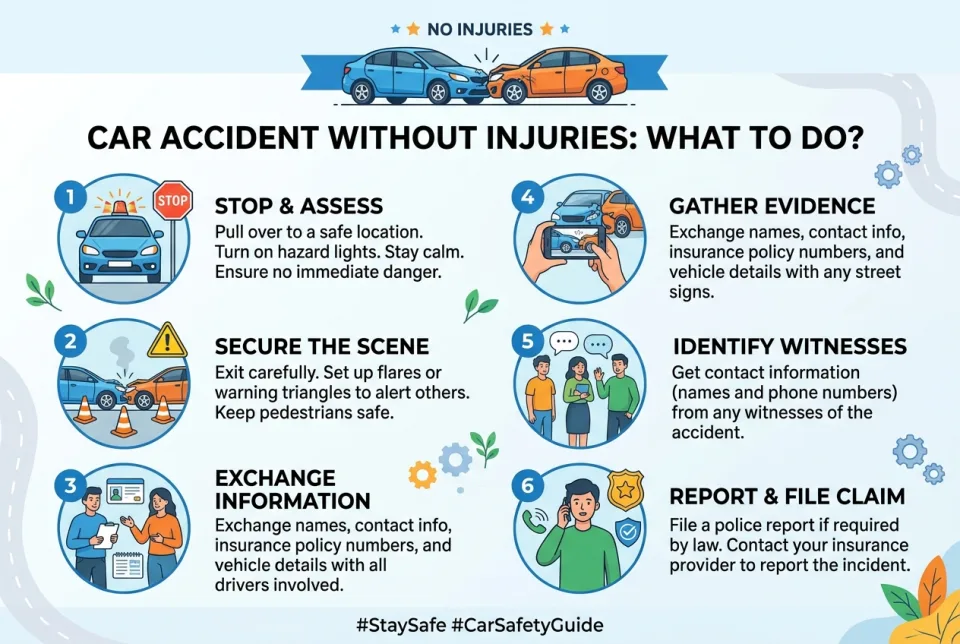
Quick answer
5 steps — read this before anything else
-
1
Move to a safe spot if possible and turn on hazard lights.
-
2
Check that everyone is unhurt; call emergency services if anyone is injured or in danger.
-
3
Exchange names, contact details, insurance and vehicle information with the other driver.
-
4
Document the scene with photos and note the location, time and conditions.
-
5
Report the accident to your insurer and, if required, to the police.
Warning
If anyone is injured, trapped, or in danger, call emergency services immediately. Do not move an injured person unless there is an immediate threat such as fire.
A car accident with no injuries is still stressful, but staying calm and following a clear sequence helps protect everyone and makes the claims process smoother. This guide covers what to do in the first few minutes and afterward.
What to do first
- Stop and secure the scene. Pull over to a safe place if the vehicles are drivable. Turn on hazard lights. If you are on a busy road, move behind a barrier or to the shoulder and stay alert to traffic.
- Check for injuries. Ask everyone involved if they are hurt. Even if people say they are fine, watch for signs of shock or delayed pain. If anyone is injured, call emergency services immediately.
- Call the police if needed. In many places you must call the police if there is significant damage, a hit-and-run, or a dispute. If unsure, call the non-emergency line for your area.
- Exchange information. Collect the other driver's name, phone number, address, insurance company, policy number, license plate, and driver's license number. Also note the make, model, and color of their vehicle.
- Document the scene. Take photos of vehicle damage from multiple angles, the overall scene, road conditions, and any skid marks or debris. Note the time, date, location, and weather. Get contact details from witnesses if possible.
- Move vehicles if safe. If the vehicles are drivable and it is safe, move them out of traffic to avoid further collisions.
What NOT to do
- Do not leave the scene without exchanging information; that can be a crime.
- Do not admit fault or argue about who caused the accident. Stick to facts.
- Do not discuss insurance details beyond what is required for the exchange.
- Do not post about the accident on social media before speaking with your insurer.
- Do not sign any document from the other party without understanding it.
When to call for help
Call emergency services if anyone is injured, if a vehicle is blocking traffic and creating a hazard, if there is a fire or fluid leak, or if the other driver appears impaired or leaves the scene. For non-emergency police assistance, use the local non-emergency number.
After the scene is cleared
- Report the accident to your insurance company promptly, even if you do not plan to file a claim. Many policies require timely notice.
- File a police report if required by local law or if the other driver was uncooperative.
- Keep a copy of all photos, notes, and the police report number in one place.
- Watch for any delayed symptoms and see a doctor if you develop pain, dizziness, or other concerns.
Taking these steps calmly helps you meet legal obligations and supports a smoother insurance process. If you are unsure about local reporting requirements, contact your local police non-emergency line for guidance.
Spotted an error? Report it — we correct factual mistakes promptly.
Read next
Accident in a rental car abroad: what to do?
A step-by-step guide to handling a rental car accident in a foreign country, from securing the scene to notifying the rental company and your insurer.
Windshield cracked by a stone: what to do?
A stone hit can turn into a dangerous crack fast. Learn how to stay safe, assess the damage, and get it fixed properly.
Airbag warning light on the dashboard: what to do?
When the airbag warning light stays on, your supplemental restraint system may not deploy in a crash. Learn the safe steps to take and when to see a mechanic.
Engine warning light on: what to do?
An engine warning light can signal anything from a loose fuel cap to a serious fault. Learn how to respond safely and when to get professional help.
Related handy tools
Checklists, decision guides, scenarios and quizzes for the same situation.