What to Do If You’re Struggling to Pay Your Bills
The rent is due Friday. The electric company sent a shutoff notice. Your card is somewhere near its limit, and you're doing the math on which bill can slide another two weeks.
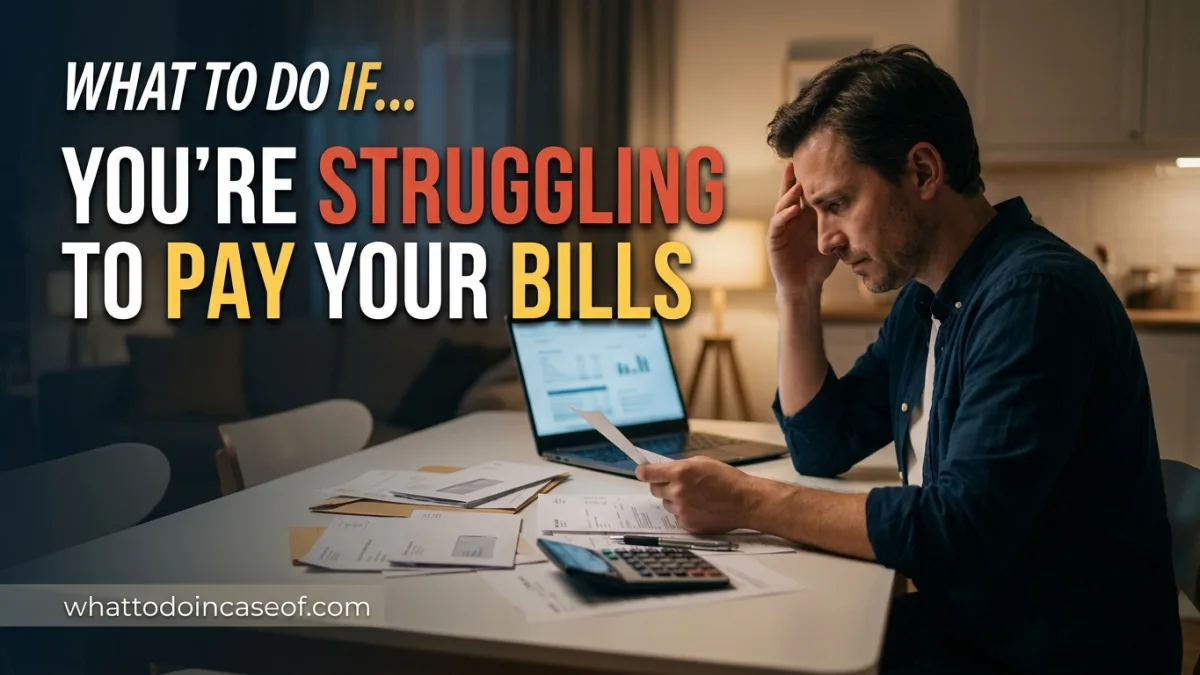
The rent is due Friday. The electric company sent a shutoff notice. Your card is somewhere near its limit, and you're doing the math on which bill can slide another two weeks.
If that sounds like your week, take a breath. You are not bad with money, and you are not alone. Millions of households hit a month where the numbers simply don't reach. The trick isn't finding a magic extra paycheck. It's making a series of small, correct decisions in the right order, starting today.
This guide walks you through what to do if you're struggling to pay your bills: what to tackle first, who to call, what to say, and which choices quietly make things worse.
The Problem
Most people in this spot do one of two things. They either ignore everything and hope it works out, or they pay the loudest bill first and let the quiet but dangerous ones slide.
Both are mistakes. Late rent can lead to eviction. An unpaid utility can lead to a shutoff and a hefty reconnection fee. A missed car payment can mean a repossession that costs you your job. Meanwhile, a medical bill sitting in collections may damage your credit without ever calling you.
The order you pay things in matters more than the total you owe. That's the part almost nobody tells you.
Why It Happens
Bills don't usually overwhelm people because of one big disaster. They pile up through a few ordinary causes.
Your income dropped or got unpredictable, maybe hours were cut or a contract ended. Your fixed costs crept up, a rent increase here, a new car payment there. A one-time hit landed, a medical emergency, a car repair, a move. Or the timing is just brutal: three bills landed in the same week and your paycheck lands the week after.
Add the fact that most billing systems are built for people with a cushion, and a small gap becomes a spiral of late fees, higher interest, and shutoff notices. Each fee makes the next month harder.
The Solutions
Here are the realistic moves, roughly in order of how much damage they prevent.
Call the people you owe, before they call you. This is the single most underused tool. Utilities, landlords, lenders, and hospitals almost all have hardship programs, payment plans, or deferral options they don't advertise. What it costs: usually nothing but a phone call and some patience. The downside is you have to ask, and it can feel humbling. Do it anyway. A payment arrangement on your record beats a shutoff or an eviction filing.
Prioritize by consequence, not by noise. Rank every bill by what happens if it goes unpaid. Housing and utilities first, then anything tied to your job (car, phone, internet if you work from home), then secured debts, then unsecured debts and medical bills last. This isn't about ignoring the rest. It's about protecting your foundation.
Trim the bleeding temporarily. Cancel subscriptions, pause non-essential auto-payments, and switch to the cheapest version of recurring costs for a month or two. This rarely fixes a real shortfall on its own, but it buys room to breathe. Be honest: cutting $40 in streaming won't cover a $400 gap, so don't rely on this alone.
Bring in one-time money. Sell things you don't use, take on a short shift or gig, ask about payment assistance programs. If you're in the US, dialing 211 connects you to local help with utilities, rent, and food. Many countries have equivalents. Your local library or community center can point you to them, and the trusted local provider directory is a good place to start if you need a specific service.
Consider formal debt relief, carefully. Debt management plans through nonprofit credit counseling, or in serious cases bankruptcy, can restructure what you owe. These have real downsides: fees, credit impact, and long timelines. They make sense when your debt is genuinely unpayable, not when you just need a few weeks of breathing room. Talk to a nonprofit counselor before you sign anything.
Ask about assistance you didn't know existed. Utility shutoff protection, rental assistance, food benefits, and medical financial aid are common and underused. Hospitals in particular often have charity care programs that reduce or erase bills for people under certain income levels. You usually have to ask.
The Best Choice
There's no single right answer, because the best move depends on your specific gap.
If your shortfall is temporary, say one bad month, focus on buying time: call everyone, set up short payment plans, and protect housing and utilities. You'll catch up within a couple of months.
If your shortfall is ongoing, meaning your income genuinely can't cover your basics, then trimming and calling won't fix it. You need to either increase income or reduce your fixed costs, and possibly pursue formal assistance or debt relief. Pretending a structural problem is a temporary one is how people end up two years deep in the same crisis.
If you're facing eviction or a shutoff this week, stop reading and call for help right now, both the creditor and a local assistance line. Time is the one thing you can't buy back.
Step-by-Step Action Plan
- List every bill with the amount, due date, and consequence of not paying.
- Mark the four walls: housing, utilities, food, and transportation to work. These get paid or negotiated first.
- Call each creditor. Say plainly: "I can't pay the full amount this month. What are my options?" Ask about hardship programs by name.
- Get any agreement in writing, even by email, so it doesn't vanish.
- Dial 211 (or your country's equivalent) to find local assistance.
- Freeze the leaks for 30 days: subscriptions, auto-payments, impulse spending.
- Check your credit report for errors and unexpected collections.
- Reassess in two weeks. If the gap is still there, it's structural, and you need a bigger plan, not more trimming.
Common Mistakes
- Paying the loudest bill first. Fix: rank by consequence, not by who calls the most.
- Avoiding the phone. Fix: creditors can't help you if you don't talk to them. Calling early almost always beats calling late.
- Using payday loans to cover the gap. Fix: they often deepen the hole with triple-digit effective rates. Look for assistance first.
- Ignoring medical bills. Fix: ask about charity care and financial assistance before they hit collections.
- Cutting only small stuff. Fix: attack the biggest fixed costs (housing, car, insurance) for real relief.
- Assuming you don't qualify for help. Fix: apply anyway. Many programs go unused because people self-reject.
- Panicking and paying in the wrong order. Fix: use the four-walls rule and make one call at a time.
Expert Takeaway
The most important lesson is this: a bill you can't pay is a negotiation, not a verdict. The moment you stop hiding and start talking to the people you owe, your options multiply. Speed beats pride every time.
FAQ
Will calling my creditors actually help? Often, yes. Many have hardship programs, payment plans, or fee waivers they only offer when asked. It won't erase the debt, but it can prevent shutoffs, evictions, and extra fees.
What bills should I pay first if I can't pay them all? Housing, utilities, food, and transportation to work. These protect your safety and your ability to earn. Unsecured debts and medical bills generally come last.
Can I get help paying utility bills? In many places, yes. Dialing 211 in the US connects you to local assistance, and many utilities have their own hardship funds. Check your utility's website or call them directly.
Is debt consolidation a good idea? Sometimes, but it depends on your situation and the terms. Talk to a nonprofit credit counselor before signing anything, and be wary of anyone charging large upfront fees.
How do I know if I need professional help? If your income can't cover your basics for more than a month or two, or if you're facing eviction or shutoff, it's time to talk to a nonprofit counselor or a local assistance program. You can also explore the practical guides and practical-knowledge blog for more step-by-step help, and keep the emergency numbers by country handy if a crisis escalates.
This article is general information, not financial or legal advice. For your specific situation, speak with a qualified professional or a local assistance program.
Need help? Call your local emergency services if you or your family are in immediate danger.
Written by
Michael Carter
Safety and first-aid editor dedicated to creating practical guides that help people understand what to do during emergencies and unexpected situations.
Spotted an error? Report it — we correct mistakes promptly.
Keep reading
Related articles
What to Do If Your Microwave Stops Working
You press start, the turntable gives a little twitch, and then nothing. Or the display is dark. Or it hums like it's thinking hard about something and never actually heats your coffee. A dead microwave is one of those small domestic emergencies that feels bigger than it should, because you only not…

What to Do If Your House Suddenly Smells Bad
I noticed it at 6:40 on a Tuesday morning, standing at the kitchen counter in socks, waiting for the coffee to finish. Something smelled like old pennies and damp cardboard. I sniffed the air like a dog. Coffee was fine. Trash was fine. And then I opened the cabinet under the sink and got a face fu…

What to Do If Your Online Order Never Arrives - 7 Steps to Get Your Money Back
That little "out for delivery" notification showed up three days ago. Since then: nothing. No knock, no package, no update. You've refreshed the tracking page so many times you know the courier's route by heart.
Related guides
Electric kettle stopped working: what to do?
Electric kettle stopped working: the right reflexes in a few simple steps.
Burned socket smell in the wall: what to do?
Burned socket smell in the wall: the right reflexes in a few simple steps.
Fever in an adult: what to do?
Fever in an adult: the right reflexes in a few simple steps.