Language barrier during an emergency abroad
When you need help fast in a country where you don't speak the language, clear communication can save lives. Learn how to get your message across and get the right assistance.
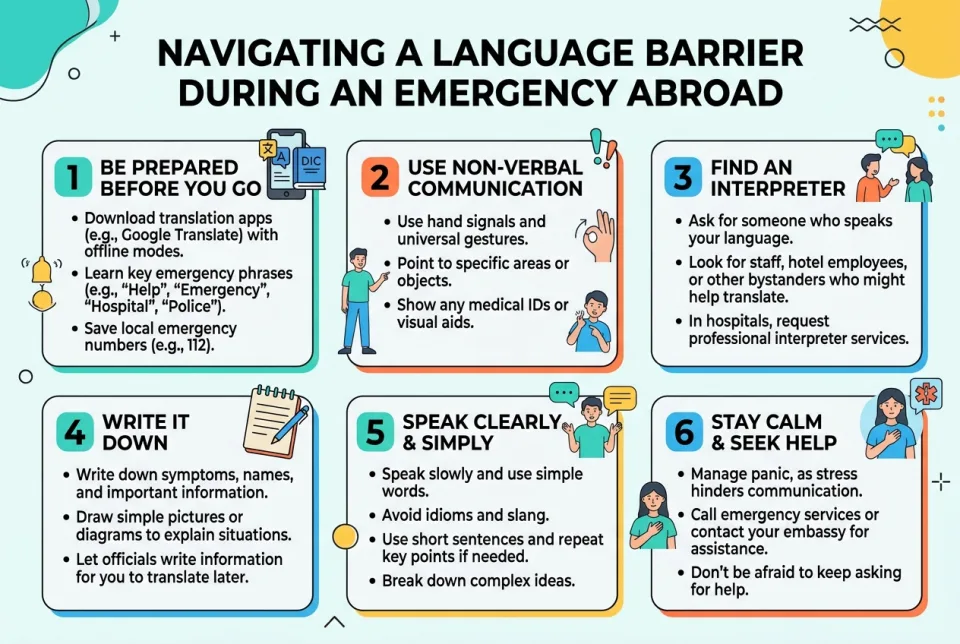
Quick answer
5 steps — read this before anything else
-
1
Call the local emergency number (e.g., 112 in the EU, 911 in the US) and speak slowly and clearly in English or use simple words.
-
2
Use a translation app or phrasebook to communicate key details: location, nature of emergency, number of people involved.
-
3
Show your location on a map or use GPS coordinates to help responders find you.
-
4
Ask for an English-speaking operator or someone who can translate.
-
5
Stay calm and repeat key information; use gestures or written notes if needed.
Warning
If you are in immediate danger, call the local emergency number right away. Do not delay to find a translator.
Important — please read
This content is general educational and informational only, and is not a substitute for professional medical advice, diagnosis or treatment. Always seek the advice of a qualified health provider with any questions you may have about a medical condition. Never disregard or delay seeking professional medical care because of something you read here. In an emergency or life-threatening situation, call your local emergency services (police, fire or ambulance) immediately.
Being in a foreign country during an emergency is stressful, and a language barrier can make it worse. But with the right approach, you can still get the help you need quickly. This guide explains what to do when you must communicate in a language you don't speak.
What is happening
You are facing an emergency abroad and cannot speak the local language well. Emergency responders may not understand your needs, and you may not understand their instructions. Clear communication is critical for a fast and effective response.
Emergency warning
If you or someone else is in immediate danger, call the local emergency number right away. Do not wait to find a translator. Emergency dispatchers are trained to handle language barriers and can connect you to an interpreter.
What to do first
- Call the emergency number. Know the local emergency number before you travel (e.g., 112 in the EU, 911 in the US, 999 in the UK). If unsure, ask hotel staff or locals.
- Speak slowly and clearly. Use simple English words. Avoid slang and complex sentences. Say "Help" and "Emergency" clearly.
- State your location first. Give the address, nearby landmarks, or use GPS coordinates. If you can't pronounce it, show your phone screen with a map.
- Describe the emergency. Use basic words: "fire," "accident," "heart attack," "bleeding," "police." Use a translation app to say key phrases if needed.
- Ask for an English speaker. Say "English speaker?" or "Interpreter?" The dispatcher may connect you to a translation service.
- Follow instructions. Listen for key words and repeat back what you understood. If you don't understand, say "I don't understand. Please repeat."
What NOT to do
- Do not hang up because you can't understand. Stay on the line and try to communicate.
- Do not use complex sentences or idioms. Keep it simple.
- Do not rely solely on translation apps for critical information; they can mistranslate. Use them as a supplement.
- Do not delay calling for help to find a translator yourself.
When to call for help
Call emergency services immediately for any life-threatening situation: severe bleeding, difficulty breathing, chest pain, fire, crime in progress, or any situation where someone could die or be seriously harmed. If you are unsure, it is better to call.
What to monitor
While waiting for help, monitor the person's condition (breathing, consciousness, bleeding). Keep the dispatcher informed of any changes. If you are told to perform first aid, do your best to follow instructions; use gestures or ask for clarification if needed.
How to prevent it
Before traveling, learn basic emergency phrases in the local language (e.g., "Help," "Call an ambulance," "I need a doctor"). Save the local emergency number in your phone. Download an offline translation app. Carry a card with your medical information and allergies in the local language. Consider learning how to say key phrases like "I am allergic to..." or "I have diabetes."
In an emergency abroad, clear and calm communication is key. Call for help immediately, use simple language, and ask for an interpreter if needed. Stay on the line and follow instructions. Your safety is the priority.
This is general information and not a substitute for professional medical advice. In an emergency, call local emergency services immediately.
Spotted an error? Report it — we correct factual mistakes promptly.
Read next
What Should You Do If Your Travel Insurance Refuses to Cover a Medical Emergency?
If your travel insurer denies a medical emergency claim, you can still get care and challenge the decision. Here is a step-by-step guide to handling the denial and protecting your finances.
What Should You Do During a Long Airport Layover? 9 Ways to Stay Comfortable and Productive
A long layover does not have to be miserable. With a little planning, you can rest, recharge, and even get work done while you wait for your next flight.
Lost debit card abroad: what to do?
Losing your debit card while traveling can be stressful. Follow these steps to secure your money, get a replacement, and access cash.
Airline cancelled my flight: what are my rights?
When your flight is cancelled, you have rights to rebooking or refund, and sometimes compensation. Learn what to do and how to claim.
Related handy tools
Checklists, decision guides, scenarios and quizzes for the same situation.