Altitude sickness on a mountain trip: what to do?
Altitude sickness can range from a mild headache to a life-threatening emergency. Learn to recognise the signs, stop ascending, and know when to descend immediately.
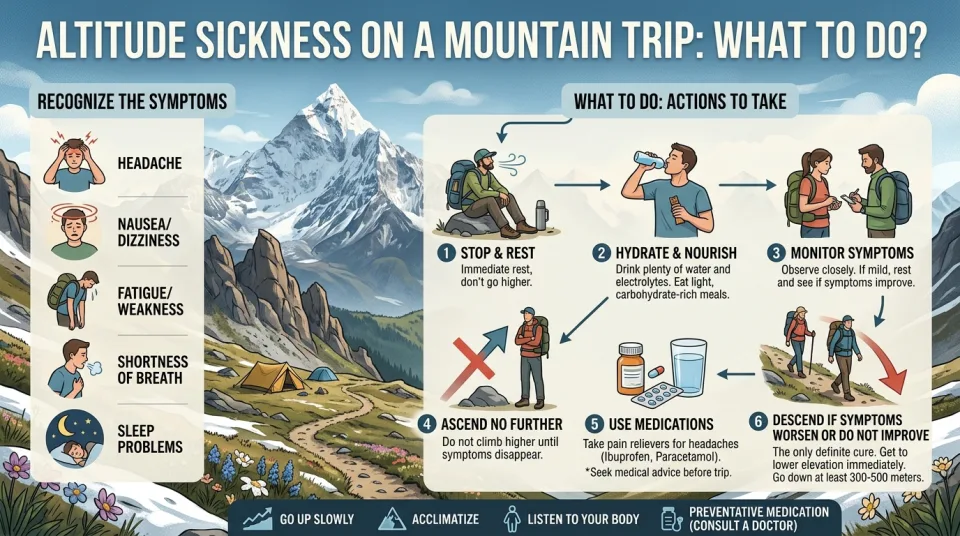
Quick answer
5 steps — read this before anything else
-
1
Stop ascending and rest at your current altitude.
-
2
Treat mild symptoms: rest, fluids, and avoid alcohol and sedatives.
-
3
If symptoms worsen or you develop breathlessness at rest, confusion, or inability to walk, descend immediately.
-
4
Call local emergency services or mountain rescue if descent is not possible or symptoms are severe.
-
5
Never ascend further while symptoms persist.
Warning
Confusion, inability to walk, breathlessness at rest or a persistent cough at altitude can mean HACE or HAPE, which are life-threatening. Descend immediately and call emergency services or mountain rescue.
Important — please read
This content is general educational and informational only, and is not a substitute for professional medical advice, diagnosis or treatment. Always seek the advice of a qualified health provider with any questions you may have about a medical condition. Never disregard or delay seeking professional medical care because of something you read here. In an emergency or life-threatening situation, call your local emergency services (police, fire or ambulance) immediately.
Altitude sickness (also called acute mountain sickness, or AMS) happens when you ascend to high altitude faster than your body can adjust to the lower oxygen levels. It is common above roughly 2,500 metres (8,200 feet), but it can occur lower in susceptible people. Most cases are mild and improve with rest, but altitude sickness can progress to two life-threatening conditions: high-altitude cerebral edema (HACE, fluid on the brain) and high-altitude pulmonary edema (HAPE, fluid in the lungs).
Emergency warning
Call local emergency services or mountain rescue immediately if someone has confusion, cannot walk in a straight line, is breathless at rest, has a persistent cough, or is unconscious. These are signs of HACE or HAPE, which can be fatal. Descent is the most important treatment, so start moving down while you call for help if you can do so safely.
What is happening
At altitude, the air pressure drops and each breath delivers less oxygen. Your body responds by breathing faster and increasing heart rate. When this compensation is not enough, symptoms of AMS appear. Mild AMS is uncomfortable but not dangerous if you stop climbing. Severe AMS, HACE and HAPE are medical emergencies.
What to do first
- Stop ascending. Do not climb higher until symptoms have fully resolved. Rest at your current altitude.
- Rest and keep warm. Sit down, avoid exertion, and stay warm. Cold and dehydration make altitude sickness worse.
- Drink fluids and eat if you can. Sip water regularly. Avoid alcohol and sleeping tablets, which can mask or worsen symptoms and slow breathing.
- Assess the severity. A mild headache, tiredness, poor appetite or mild nausea that improves with rest is usually mild AMS. Watch closely for the warning signs below.
- Descend if symptoms worsen. A descent of a few hundred metres often brings rapid relief. Do not wait for severe symptoms before going down.
Warning signs that mean descend now
- Headache that does not respond to rest and simple pain relief, or that keeps getting worse
- Vomiting or inability to keep fluids down
- Confusion, drowsiness, unusual behaviour, or difficulty walking in a straight line
- Breathlessness at rest, a persistent cough, or coughing up pink frothy sputum
- Blue lips or fingertips, or a very fast heartbeat
Any of these means the person may have HACE or HAPE. Descend immediately and call for help. Do not leave the person alone.
What NOT to do
- Do not keep climbing to "see how it goes". Ascending with symptoms is the main cause of dangerous altitude sickness.
- Do not use alcohol, sedatives or sleeping tablets to manage symptoms.
- Do not ignore confusion or breathlessness at rest. These are emergencies, not normal tiredness.
- Do not send a severely affected person down alone.
When to call for help
Call emergency services or mountain rescue if the person cannot walk, is confused, is breathless at rest, or if weather or terrain makes descent unsafe. If you have a satellite messenger or phone signal, use it. Give your location, altitude, symptoms and how many people are affected.
How to prevent it
- Ascend gradually. Above 2,500 metres, keep sleeping altitude gains modest and include rest days.
- Avoid flying or driving straight to high altitude if you can build in acclimatisation.
- Stay hydrated, eat regularly, and avoid alcohol in the first days at altitude.
- Learn the symptoms before you go and agree with your group that anyone can call a stop.
If symptoms are mild, rest and monitor closely. If they do not improve within a day, or if any warning sign appears, descend and seek medical help. Do not resume climbing until you are fully well.
This is general information and not a substitute for professional medical advice. In an emergency, call your local emergency services immediately.
Sources & references
Spotted an error? Report it — we correct factual mistakes promptly.
Read next
What Should You Do If You Forget to Pack Something on a Trip?
Forgot an essential item? Use these practical travel hacks to find a replacement quickly, from hotel front desks to local stores and digital workarounds.
What to Do If You Lose Your Credit Card While Traveling
Losing a credit card abroad requires quick action. Follow these essential steps to lock your account, secure emergency funds, and prevent fraud.
What to Do in Case of a Lost Passport
If you lose your passport while traveling, act quickly to search your belongings, report the loss to police, and contact your embassy for an emergency replacement.
What to Do in Case of a Delayed Flight
Learn what immediate steps to take when your flight is delayed, including how to check your rights, secure food or lodging vouchers, and arrange rebooking.
Related handy tools
Checklists, decision guides, scenarios and quizzes for the same situation.