How can I immigrate to Canada - Quietest Border Crossing in the World
Canada welcomed 500,000 newcomers in 2026, but the rules have changed. Here's the real, step-by-step guide to immigrating through Express Entry and Provincial Nominee Programs — with actual costs, timelines, and the one strategy that actually works.
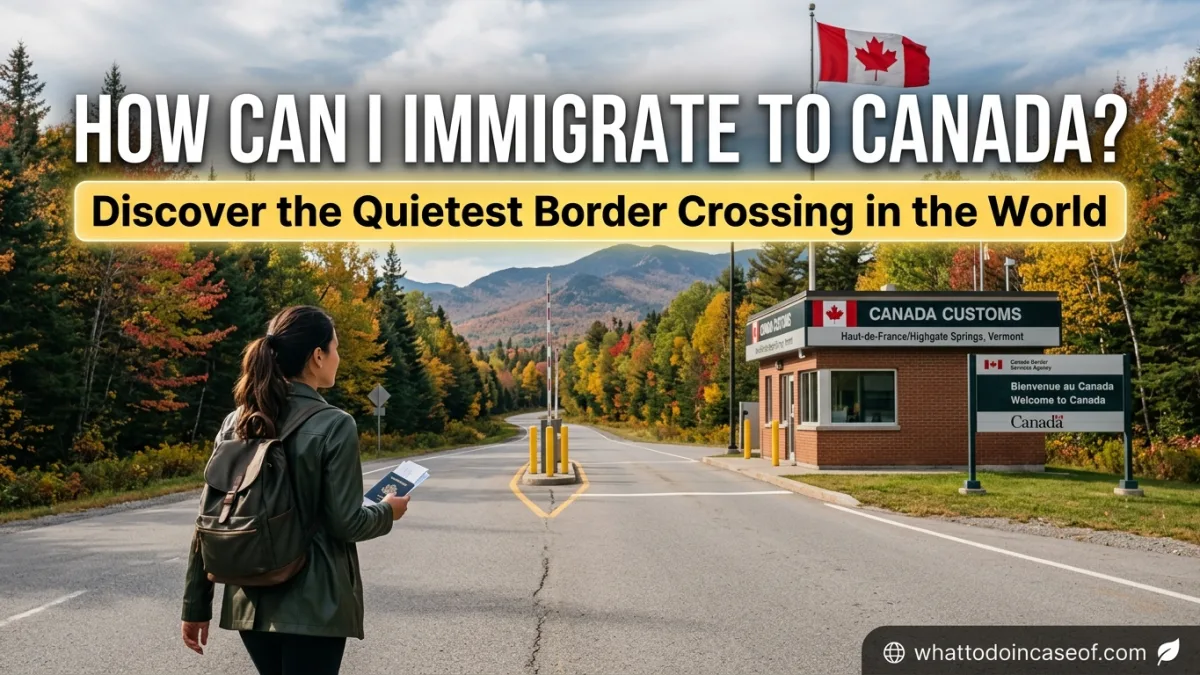
The Quietest Border Crossing in the World — and Why Half a Million People Are Still Desperate to Cross It
At 8:47 on a Tuesday morning in March, the Peace Arch border station between Blaine, Washington and Surrey, British Columbia processes its first wave of travelers. There is no wall, no razor wire, no dramatic checkpoint. Just two flags, a flower garden, and a customs officer who asks, almost conversationally, "Purpose of your visit?"
Yet behind that polite question lies one of the most competitive migration gateways on earth. In 2026, Canada plans to welcome roughly half a million new permanent residents. The Express Entry pool alone holds over 232,000 candidates waiting for an invitation. And if you are reading this from outside Canada — no Canadian job offer, no Canadian degree, no aunt in Toronto — the path that once looked straightforward has quietly transformed into something more strategic, more provincial, and more expensive than it was even two years ago.
So how do you actually immigrate to Canada in 2026? Not in theory. In practice.
The Question Everyone Is Really Asking
Search "how to immigrate to Canada" and you will find a thousand listicles. Most of them are wrong, or at least outdated. They still describe Express Entry as a simple points race where a strong resume and a language test guarantee an invitation. They do not mention that the federal government suspended generalized draws in 2025, or that a candidate with a base score of 110 can now receive permanent residence while someone with 480 waits indefinitely.
The real question is not can you immigrate to Canada. It is: which doorway is actually open to you, and are you standing in front of the right one?
What Changed — and Why It Matters
Canada's immigration system has three main federal economic streams: the Federal Skilled Worker Program, the Canadian Experience Class, and the Federal Skilled Trades Program. All three feed into Express Entry, a points-based pool where candidates are ranked by the Comprehensive Ranking System, or CRS.
For years, the strategy was simple. Get a high CRS score — through language proficiency, education, work experience, and age — and wait for a federal draw. If your score cleared the cutoff, you received an Invitation to Apply, or ITA. In 2023, that cutoff often hovered around 490. By late 2024, it had climbed past 520.
Then, in 2025, the rules changed. The federal government shifted away from general all-program draws and toward targeted, category-based selections. If you are applying from outside Canada with no Canadian work experience, the Canadian Experience Class is structurally unavailable to you. Category-based draws favor specific occupations — healthcare, STEM, trades, transport, agriculture — and even then, competition is fierce.
This is where the story takes a turn.
The Provincial Plot Twist
The Provincial Nominee Program, or PNP, has become the single most important pathway for overseas skilled workers in 2026. Canada's 2026–2028 immigration levels plan targets 91,500 PNP admissions this year alone. When a province nominates you through an Express Entry-aligned stream, Immigration, Refugees and Citizenship Canada awards you 600 additional CRS points automatically.
To understand what that means in practice: a candidate with a base CRS of 142 who receives a provincial nomination suddenly has a score of 742. In the most recent PNP-specific federal draw, the cutoff was 742. That candidate, who would never have qualified through a general draw, is now guaranteed an invitation.
The provinces with the largest quotas and most active programs include Ontario, Alberta, Saskatchewan, and Nova Scotia. Each operates differently. Ontario's Human Capital Priorities stream scans the federal pool and issues Notifications of Interest to candidates with specific NOC codes. Alberta's Accelerated Tech Pathway targets software engineers and IT professionals with a minimum CRS of just 300. Saskatchewan maintains an active Expression of Interest system with a transparent points grid. Nova Scotia runs dynamic draws based on live labour market data.
The strategy that works in 2026 is not to optimize one federal profile and hope. It is to enter multiple provincial pools simultaneously, align your NOC code precisely with provincial demand, and treat each province as a separate opportunity with its own timeline.
What It Actually Costs
Immigration to Canada is not free, and in 2026, it is more expensive than it has ever been. On April 30, 2026, IRCC increased permanent residence fees across nearly every category.
For economic immigration — Express Entry, Provincial Nominee Programs, and most skilled worker streams — the principal applicant now pays $1,590, which includes both the processing fee and the Right of Permanent Residence Fee. A spouse or common-law partner adds another $1,590. Each dependent child costs $270. Biometrics, required for most applicants, add $85 per person.
If you are a family of four applying through Express Entry or a PNP, your government fees alone will exceed $3,800 before you pay for language tests, educational credential assessments, medical exams, police certificates, or courier charges.
Then there is the proof of funds requirement. For 2026, a single applicant must show $15,263 in available settlement funds. A family of four needs $28,362. These are not application fees — they are savings you must demonstrate you have access to, and IRCC scrutinizes the source of those funds more carefully than ever.
The Step-by-Step Reality
The safest approach is to choose your route first, then build your documents around it. Most delays happen because applicants start collecting police certificates or employment letters after a deadline has already started.
Begin with an honest eligibility assessment. If you have no Canadian work experience and no job offer, your viable path in 2026 is almost certainly a Provincial Nominee Program. Create your federal Express Entry profile, but do not stop there. Submit active Expressions of Interest to Alberta, Saskatchewan, and any other province where your occupation appears on a demand list. Optimize your NOC code to match provincial algorithms — remember, provinces assess your specific job duties against the National Occupational Classification matrix, not your job title.
Simultaneously, begin your document spine. Order sealed transcripts for your educational credential assessment. Book your language test early — IELTS or CELPIP for English, TEF or TCF for French — and aim for Canadian Language Benchmark 9 or higher if possible. Gather birth certificates, marriage documents, and a complete address history. Request police certificates from every country where you have lived for six months or more since turning eighteen.
The full timeline, from initial profile creation to landing in Canada, typically spans eight to eighteen months for PNP candidates, though processing varies significantly by province and by the complexity of your file.
Where Will You Actually Live?
Here is a question that gets surprisingly little attention in immigration forums: once you have permanent residence, where should you settle?
Toronto and Vancouver dominate the imagination, but they also dominate the cost-of-living rankings. A software developer earning $85,000 CAD will live very differently in Calgary than in Vancouver. A nurse nominated through Nova Scotia's stream may find home ownership achievable in Halifax in a way that would be impossible in the Greater Toronto Area.
Before you commit to a province — especially if your nomination includes a requirement to reside there — use tools like Where Can I Live to compare how far your salary will stretch across Canadian cities. The calculator factors in housing, food, transport, and lifestyle preferences across more than 315 cities worldwide, including every major Canadian market. It is the kind of reality check that prevents the post-arrival shock that sends too many newcomers back to the drawing board within their first year.
When Things Do Not Go According to Plan
Immigration is rarely a straight line. Flights get canceled. Documents go missing. Medical exams reveal unexpected issues. Border officers ask questions you did not prepare for.
For practical, step-by-step guidance on travel documentation, lost paperwork, and the administrative surprises that can derail a move, What to Do In Case Of maintains detailed guides on visas, travel formalities, and everyday administrative procedures. Their travel section covers everything from missed connections to passport emergencies, while their administration and legal guides walk through lost documents and official procedures step by step. It is worth bookmarking before you book your one-way ticket.
What the Numbers Actually Tell Us
Canada is not tightening its borders. If anything, the country is expanding its immigration targets. But the mechanism of selection has shifted decisively from a single federal queue to a decentralized, province-driven system. The candidates who succeed in 2026 are not necessarily the ones with the highest CRS scores. They are the ones who understand that immigration is no longer just a federal competition — it is thirteen separate provincial competitions, each with its own rules, its own timing, and its own definition of who qualifies.
The general all-program draw may return someday. For now, it is gone. And the 232,000 candidates still waiting in the federal pool are learning, one by one, that the fastest route to a Canadian permanent residence card runs through a provincial capital, not Ottawa.
What to Remember
- Express Entry alone is rarely enough for overseas applicants in 2026. The PNP is now the dominant viable pathway.
- A provincial nomination adds 600 CRS points, effectively guaranteeing a federal invitation in the next PNP-specific draw.
- Apply to multiple provinces simultaneously. Provincial windows open and close without warning.
- Fees increased on April 30, 2026. Budget at least $1,590 for the principal applicant, plus $1,590 for a spouse and $270 per child.
- Proof of funds is mandatory. A single applicant needs $15,263; a family of four needs $28,362.
- NOC codes matter more than job titles. Provincial algorithms match your duties, not your business card.
- Research your destination city before you land. Cost of living varies dramatically across Canada.
FAQ
Can I immigrate to Canada without a job offer in 2026?
Yes. The Provincial Nominee Program is the primary pathway for skilled workers without a Canadian job offer. Candidates with base CRS scores as low as 110 have received nominations and federal invitations this year.
How much does it cost to immigrate to Canada as a skilled worker?
For economic immigration, the principal applicant pays $1,590 (including the Right of Permanent Residence Fee). A spouse adds $1,590, and each dependent child adds $270. Biometrics cost $85 per person. Additional costs for language tests, educational assessments, and medical exams typically add several hundred dollars more.
What is the minimum CRS score needed for Express Entry in 2026?
It depends entirely on your pathway. PNP-specific federal draws range from CRS 710 to 789, but that includes the 600-point provincial bonus — meaning base scores as low as 110 to 189 can succeed. Canadian Experience Class draws require roughly 507 to 511. General all-program draws are currently suspended.
How long does the Canadian immigration process take?
For Provincial Nominee Program candidates, the full timeline from profile creation to landing typically ranges from eight to eighteen months. Processing times vary by province, stream, and the completeness of your application.
Do I need to hire an immigration consultant or lawyer?
No. Many applicants successfully navigate the process independently. However, given the complexity of provincial strategies and NOC alignment in 2026, some candidates choose to consult a Regulated Canadian Immigration Consultant (RCIC) or lawyer — particularly if applying to multiple provinces simultaneously.
Written by
Mohamed IDBRAHIM
I oversee the platform's development, content strategy, quality standards, and overall user experience. My goal is to make WhatToDoInCaseOf.com a reliable and practical resource where people can quickly find clear, useful information about what to do when facing everyday problems, unexpected situations, important decisions, and life challenges. I work to ensure that the platform remains easy to use, accessible, informative, and continuously improved with helpful guides, tools, calculators, and practical resources. Through a focus on clarity, usefulness, and innovation, I am committed to building a platform that helps people better understand their options and take the next step with confidence.
View profileSpotted an error? Report it — we correct mistakes promptly.
Keep reading
Related articles

Can I Move to Canada Without a Job Offer?
Yes, you can move to Canada without a job offer. Discover the realistic pathways — Express Entry, Provincial Nominee Programs, study permits, and more — with a step-by-step action plan.

What Is the Easiest Way to Move to Canada?
Discover the easiest way to move to Canada in 2026. Learn why provincial nominee programs now outperform Express Entry, with real costs, timelines, and a step-by-step action plan.

What to Do If You Forget Your Wi-Fi Password
Your laptop says "incorrect password." Your phone forgot the network. A guest asks for the Wi-Fi and you freeze, because you have not typed that string of letters and numbers since the day the router arrived.
Related guides
What to Do If Your Visa Application Is Delayed or Denied
Step-by-step guidance on how to track delayed visa applications, address visa refusals, and determine your legal options for reapplication or appeal.
What To Do If Your Visa Is About to Expire
If your visa is nearing its expiration date, immediate action is essential to avoid unlawful presence, fines, or deportation. Learn the exact steps to extend your stay, change status, or prepare for a timely departure.
Debt collectors keep calling: what to do?
Debt collectors keep calling: the right reflexes in a few simple steps.