What to Do If Your Car Battery Dies - 8 Steps to Get Back on the Road
You turn the key. Instead of the engine catching, you get a slow, sickly groan, then a click, then nothing. The dashboard lights dim. Somewhere in the back of your mind you already know: the battery is dead, and you're stuck.
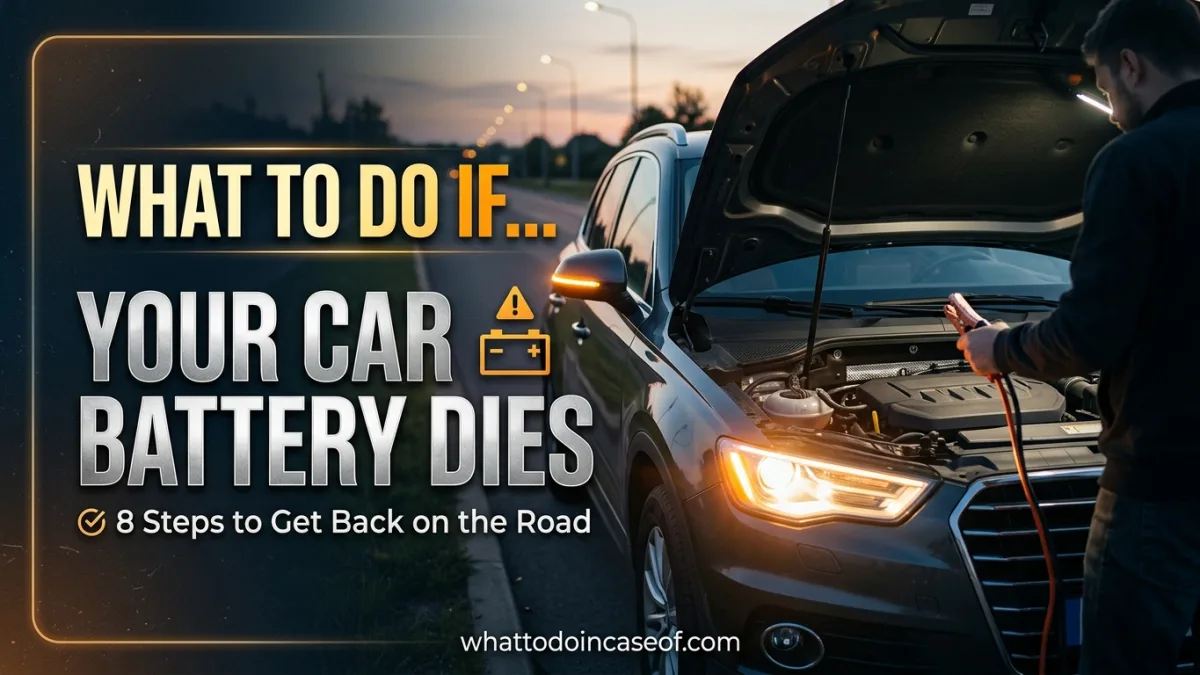
You turn the key. Instead of the engine catching, you get a slow, sickly groan, then a click, then nothing. The dashboard lights dim. Somewhere in the back of your mind you already know: the battery is dead, and you're stuck.
It's one of the most common car problems there is, and almost nobody plans for it. The good news is that a dead battery is rarely a disaster. In most cases you can be moving again within half an hour, and the fix is simpler than you'd think. This guide walks you through what's actually happening, your realistic options, and an 8-step action plan that works whether you're in your own driveway or a parking lot across town.
Why does my car battery die so suddenly?
Batteries don't usually fail with a warning. They limp along for weeks, then quit all at once on a cold morning or after a short trip. One day it starts fine, the next it won't turn over.
That suddenness is what catches people out. They assume a dead battery means something is seriously wrong with the car. Usually it doesn't. It means the battery has reached the end of its life, or something drained it while the car sat.
The most common mistake is panicking and calling a tow truck before checking the obvious things. A second mistake is trying to jump-start a battery that's frozen, cracked, or leaking, which can be genuinely dangerous. We'll cover both below.
Why it happens: the usual suspects
A car battery is a chemical device. It stores energy and releases it to crank the engine and run the electronics. Over time, that chemistry wears out.
Here's what typically kills a battery:
Age. Most car batteries last somewhere between three and five years. After that, they get weaker and less able to hold a charge, especially in cold weather.
Something left on. Interior lights, a phone charger, a dashcam, a trunk light that never quite shuts. A small drain overnight is often all it takes.
Short trips. If you only drive a few minutes at a time, the alternator never gets long enough to fully recharge what starting the car used up. Over weeks, the battery slowly runs down.
Corroded or loose terminals. Poor connections stop power getting where it needs to go, even if the battery itself is fine.
Extreme temperatures. Cold slows the chemical reaction inside the battery. Heat speeds up the wear. Both shorten its life.
A failing alternator. If the alternator isn't charging while you drive, the battery drains as you go and eventually dies. This one matters, because a jump-start won't fix it for long.
Your realistic options when the battery is dead
You've got a few paths out of this. Which one is right depends on where you are, what you have on hand, and how much time and money you want to spend.
1. Jump-start from another car
This is the classic fix, and for most people it's the fastest.
What it is: You connect your dead battery to a working one using jumper cables, let the good car run, then start yours.
How it works: The running car's alternator supplies the current to crank your engine. Once your car is running, your own alternator recharges your battery.
Advantages: Free if you have cables and a willing helper. Fast.
Disadvantages: You need another car and another person. Done wrong, it can damage electronics or cause a spark near battery gas. Newer cars with sensitive electronics can be fussy about it.
When it makes sense: You're somewhere safe, someone can reach you, and you have jumper cables.
2. A portable jump starter
What it is: A small battery pack, about the size of a large paperback, that you clip onto your battery and use to start the car yourself.
How it works: Same idea as jumper cables, but the power comes from the pack instead of another vehicle.
Advantages: No second car needed. You can keep one in the trunk and solve this alone. Many double as phone chargers.
Disadvantages: Costs money up front (roughly $50 to $150 depending on brand and power). Needs to be kept charged, which people forget.
When it makes sense: You'd rather not depend on strangers, or you've been stranded before and don't want a repeat.
3. Call roadside assistance
What it is: A service that comes to you, jumps the car, and sometimes replaces the battery on the spot.
How it works: You call, they dispatch a technician. Many insurance policies, auto clubs, and credit cards include this.
Advantages: You don't need to know anything about cars. Someone else handles it.
Disadvantages: You wait. It can take 30 minutes or several hours depending on where you are. Without coverage, it costs money.
When it makes sense: You're on a highway, it's dark, you have no tools, or you simply don't want to deal with it.
4. Push-start (manual transmission only)
What it is: You and a helper push the car while it's in gear to bump the engine to life.
How it works: Rolling the car turns the engine manually, and with the ignition on, it can fire up.
Advantages: Free, no cables needed.
Disadvantages: Only works on manual cars. Needs a helper, a flat or downhill surface, and some nerve. Not safe in traffic.
When it makes sense: Rarely, and only if you know what you're doing and it's safe to try.
5. Replace the battery
What it is: If the battery is old or damaged, you swap it for a new one.
How it works: You buy a replacement and install it, or have someone install it for you.
Advantages: Fixes the problem for good if the battery was the cause.
Disadvantages: Costs money (often $100 to $250 depending on the car and battery type). Does nothing if the real problem is the alternator.
When it makes sense: The battery is old, cracked, swollen, or won't hold a charge even after a jump.
Which option is best for you?
There's no single right answer here, and anyone who tells you otherwise is oversimplifying.
If you're at home with a second car handy, jumper cables are the obvious move. If you're alone in a parking garage, a portable jump starter earns its keep. If you're stranded on a shoulder at night with traffic flying past, call for help and stay safe; that's not the moment to learn how jumper cables work.
The honest rule: match the tool to the situation, not the other way around. And if the battery is more than four or five years old, don't just jump it and forget it. Start planning a replacement, because it will strand you again.
The 8-step action plan
Here's the sequence. Follow it in order and you'll handle this calmly.
Step 1: Stay calm and get to safety. If the car stalled in traffic or on a road, put your hazard lights on. If you can, get the car to the shoulder or a safe spot. Safety first, always.
Step 2: Confirm it's the battery. Turn the key (or press start). Do the lights come on but the engine won't crank? Do you hear a click or a slow groan? That points to the battery. Complete silence with no lights could be something else, like a bad connection or a blown fuse.
Step 3: Check the terminals. Look at the battery. Are the cables loose, or caked in white or blueish powder? A loose or corroded connection can mimic a dead battery. If a terminal is loose, and only if you're confident, a careful tighten might be all you need.
Step 4: Look for damage. Is the battery cracked, leaking, swollen, or frozen? If so, stop. Do not jump-start it. A damaged battery can leak acid or, in rare cases, rupture. Call for professional help instead.
Step 5: Choose your method. Jump-start, portable pack, roadside service, or replacement. Use the section above to pick.
Step 6: Do the jump safely. If using cables, connect positive to positive first, then negative to a bare metal point on the dead car (not the battery itself). Start the good car, let it run a few minutes, then try yours. If using a portable pack, follow its instructions exactly.
Step 7: Let it run. Once your car starts, don't switch it off right away. Drive it for at least 20 to 30 minutes, ideally on a road rather than idling, so the alternator can recharge the battery. If you have somewhere to be, head straight there and keep the engine running.
Step 8: Get it checked. A jump is a rescue, not a repair. Within a day or two, have the battery and charging system tested. Most auto parts stores will test a battery for free. If it's on its last legs, replace it before it strands you again.
For more step-by-step guides on everyday emergencies, the practical guides section is worth bookmarking before you need it.
Common mistakes to avoid
Jumping a damaged or frozen battery. Visually check first. A cracked, leaking, or swollen battery is a no-go. Fix: if in doubt, don't jump it; call for help.
Connecting the cables in the wrong order. This can cause sparks or damage electronics. Fix: positive first, negative last, and make the final negative connection on bare metal, not the battery.
Assuming a jump is a permanent fix. It isn't. Fix: get the battery tested within a couple of days.
Leaving the engine idling to "charge it up." Idling charges slowly. Fix: drive it for 20 to 30 minutes instead.
Ignoring the alternator. If a new battery keeps dying, the alternator is the likely culprit. Fix: have the charging system checked, not just the battery.
Trying to push-start an automatic. It won't work and can damage the transmission. Fix: only attempt this on a manual, and only if it's safe.
Keeping a portable jump starter uncharged. The one time you need it, it's flat. Fix: check its charge every few months.
Expert takeaway
The single most important lesson: a dead battery is a warning, not just an inconvenience. Jump it, get moving, then find out why it died. If it's simply old, replace it and move on. If it keeps happening, something else is draining or failing, and ignoring that will leave you stranded again, probably at the worst possible moment.
Frequently asked questions
Can I jump-start my car alone? Yes, if you have a portable jump starter. With traditional jumper cables you need a second vehicle and a helper.
How long should I drive to recharge a dead battery? Aim for at least 20 to 30 minutes of actual driving, not idling. Longer is better if the battery was deeply drained.
How do I know if it's the battery or the alternator? If the car starts after a jump but dies again soon, or if the battery light stays on while driving, suspect the alternator. A free test at an auto parts store can tell you.
Is it safe to jump-start a car in the rain? It can be done, but water and electricity don't mix well. Keep connections dry, avoid touching metal, and if conditions feel unsafe, call for professional help instead.
What if my battery keeps dying? Something is draining it or not charging it. Common causes include a faulty alternator, a parasitic drain (something staying on), or an old battery. Get it diagnosed properly rather than jumping it over and over. If you're unsure who to call, the trusted local provider directory can point you toward help in your area.
This article is general information, not a substitute for professional advice. If you're unsure about anything electrical, have a qualified mechanic take a look.
Written by
Mohamed IDBRAHIM
I oversee the platform's development, content strategy, quality standards, and overall user experience. My goal is to make WhatToDoInCaseOf.com a reliable and practical resource where people can quickly find clear, useful information about what to do when facing everyday problems, unexpected situations, important decisions, and life challenges. I work to ensure that the platform remains easy to use, accessible, informative, and continuously improved with helpful guides, tools, calculators, and practical resources. Through a focus on clarity, usefulness, and innovation, I am committed to building a platform that helps people better understand their options and take the next step with confidence.
View profileSpotted an error? Report it — we correct mistakes promptly.
Keep reading
Related articles
What to Do If Your Car Air Conditioning Stops Working - 9 Things to Check
You're stuck in traffic on a hot afternoon, and the air coming out of your vents is doing a bad impression of a hair dryer. You push the button harder, turn the dial to maximum, and nothing changes. It's one of those small failures that ruins a whole drive, and if you have kids or pets in the back,…
What to Do If Your Check Engine Light Comes On
You're driving along, everything's fine, and then that little amber engine icon lights up on your dashboard. Your stomach drops a bit. Is the car about to die? Are you about to be handed a four-figure repair bill?

What to Do If You Miss Your Flight: A Complete Airport Survival Guide
Missed your flight? Don't panic. Learn exactly what to do if you miss your flight, from rebooking strategies to passenger rights, with this essential airport travel guide.
Related guides
What to Do If Your Car Breaks Down in Canada
A breakdown in Canada requires immediate safety precautions, especially during severe winter weather or on high-speed highways. Learn how to stay safe, call for assistance, and handle extreme conditions.
Driving in snow without chains: what to do?
Driving in snow without chains: the right reflexes in a few simple steps.
Key fob battery dead: how to start the car?
Key fob battery dead: the right reflexes in a few simple steps.